روغن موتور تمام سنتتیک
  روغن موتور دیزلی
  روغن دنده
  روغن موتور سیکلت
 Nourishing the Spiritual Blood of the Oil Industry
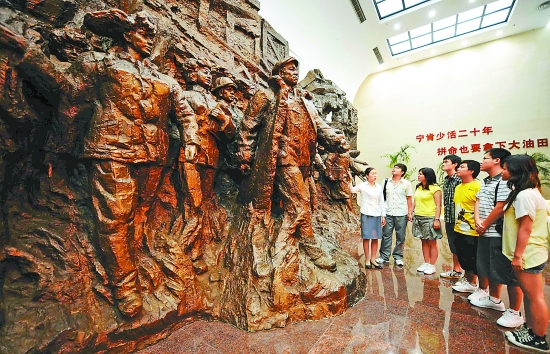
The Daqing Spirit was gradually cultivated and formed by the older generation of leaders on the oil front and the broad ranks of oil workers, at a difficult time, in a difficult place and under difficult conditions, by studying and applying Mao Zedong Thought, carrying on and developing the fine traditions of the Communist Party of China, the Chinese working class and the Chinese People's Liberation Army and in the practice of developing and building the Daqing Oilfield. It is an inheritance and development of the revolutionary spirit of the war years and an important component of the spirit of the Chinese nation. Its basic content is: the patriotic spirit of winning glory for the country and winning honour for the nation, the spirit of hard pioneering through independence and self-reliance, the realistic spirit of respecting science and of 'three honest and four strict', and the spirit of dedication that keeps the overall situation in mind and shares the country's worries. Whether in the past, the present or the future, the Daqing Spirit is an important spiritual force inspiring people to keep pressing forward.
The Daqing Spirit was conceived and born in the Daqing petroleum battle. That battle was conducted at a difficult time, in a difficult place and under difficult conditions. At that time hostile foreign forces imposed an economic blockade and military threat on our country, the country suffered natural disasters for three consecutive years, the national economy was in serious difficulty and the country urgently needed oil. Faced with a harsh natural environment and a severe shortage of financial and material resources, the broad ranks of oil workers represented by Wang Jinxi were not daunted; through earnestly studying On Practice and On Contradiction they strengthened their determination and confidence to overcome every difficulty, and under extremely hard conditions they formed the dauntless spirit of 'when conditions permit we must go ahead; when conditions do not permit we must create the conditions and go ahead anyway'. Faced with a lack of experience in developing and managing a large oilfield, the broad ranks of workers combined a high revolutionary spirit with a strict scientific attitude and formed the fine work style of 'being honest people, speaking honest words and doing honest things' and of 'strict requirements, tight organization, a serious attitude and strict discipline'. At that time the state had limited funds for developing the Daqing Oilfield. In handling the relationship between the state and the individual and between production and living, the Daqing oil workers proposed 'the state first, the individual after' and 'production first, living after', and with the heroic bearing of 'rather lose twenty years of life than fail to win the big oilfield' they fought hard for three years and secured the Daqing Oilfield, in one stroke casting off the label of being oil-poor that had long weighed on the Chinese people.
The Daqing Spirit was born in production practice and is also continuously enriched and developed in production practice, always maintaining its advanced nature and its relevance to the times.
In the new period, 'patriotism, enterprise, realism and dedication' has become the corporate spirit of PetroChina and has been given new content.
Development Milestones
September 26, 1959
Well Songji 3 gushed industrial oil flow, marking the discovery of the Daqing Oilfield
April 29, 1960
The Daqing petroleum battle officially began
May 1962
A single fire brought the post responsibility system into being
September 1963
'Three honest and four strict, four the same' first publicized in Daqing's Battle News
January 1964
Mao Zedong issued the call 'In industry, learn from Daqing'
1978
National annual crude oil output exceeded 100 million tons for the first time, reaching 104 million tons
April 1981
A policy of contracting crude oil output at the 100 million ton level was introduced in the oil industry, mobilizing the production enthusiasm of oil enterprises
September 1986
The Daqing Oilfield entered the ranks of the world's ten largest oilfields
September 1988
The State Council abolished the Ministry of Petroleum Industry and established China National Petroleum Corporation
July 1998
The business of China National Petroleum Corporation was further reorganized and China National Petroleum Group Corporation was established
April 2000
PetroChina Company Limited was listed on the Hong Kong Stock Exchange
2002
The Daqing Oilfield achieved high and stable production of 50 million tons for the 27th consecutive year
December 2007
The Daqing Oilfield won one of the first 'China Industrial Awards'
March 2009
Total crude oil production at Daqing exceeded 2 billion tons
July 2015
The group company launched a great discussion activity themed 'Carry Forward the Glorious Tradition, Reshape a Good Image'
January 2016
The group company set the development goal of building a world-class comprehensive international energy company
March 2016
When joining the deliberation of the Heilongjiang delegation, General Secretary Xi Jinping delivered an important speech: Daqing is the nation's benchmark and banner
Fine Traditions
'Two Theories' as the Foundation of the Enterprise: the Basic Skill of the Daqing Oilfield
[Content] All the work of the battle was organized using the standpoints, viewpoints and methods of On Practice and On Contradiction.
[Origin] In the early days of the Daqing oilfield battle, many problems arose in the thinking of the employees: some had doubts about the petroleum battle; some, faced with a difficult environment, developed a fear of hardship, especially in the face of such an extra-large oilfield of more than a thousand square kilometers, and lacked practical experience in exploration and development. Faced with layer upon layer of contradictions and difficulties, Yu Qiuli and the other battle leaders held that in their thinking as leaders they must not deal with matters as they stood or treat the head for the headache and the foot for the footache. They had to see through appearances to the essence and grasp the principal contradiction and the principal aspect of that contradiction.
Once the principal contradiction is resolved, the other problems will be readily solved. To this end, the Party committee of the ministry's head office, the Party's interim office in the early days of the Daqing battle, issued a decision on April 10, 1960, organizing the whole battle force to earnestly study Chairman Mao's On Practice and On Contradiction, and called on them to use the standpoints, viewpoints and methods of the 'two theories' to organize all the work of the battle.
The decision to study the 'two theories' won the support of the broad ranks of employees. Cadres read it, technicians read it and workers read it; at night people gathered around bonfires to study the 'two theories'. Through studying them the battle force came to realize with one voice that of all difficulties the shortage of oil in the country was the greatest, and that of all contradictions the fact that socialist construction was waiting for oil was the principal one. Studying the 'two theories' laid the foundation for the final victory of the battle.
[Significance] Founding the enterprise on the 'two theories' meant striving to master Marxist philosophy, that powerful ideological weapon for understanding and changing the world, and striving to clear away the influence of idealism and metaphysics, gradually coming to understand the concrete reality of the Daqing Oilfield and the laws of oilfield development and construction and solving a series of problems in the battle work.
'Advancing by the Two-Point Method': the Expression of the Oil Workers' Enterprising Spirit
[Content] The 'two-point method' means: first, at any time and in regard to anything, one must use the 'two-point method'. The greater the achievements and the better the situation, the more one must look at things in two. To look only at achievements and only at the good side will lead to arrogance and complacency in thinking, turn achievements into a burden and cause a fine situation to turn into its opposite.
Second, the 'two-point method' must also be applied to drive. Once drive arises, if it is not properly guided people will seek only speed and ignore quality, and the result will be that good intentions fail to produce good effects and the enthusiasm of the employees is dampened instead.
Third, leaders must promptly put forward new, clear, high standards that can be reached through effort, guiding employees to always look forward.
Fourth, using the 'two-point method' as a weapon, one must persist in doing a good job of work summaries, looking at the next step while taking the present one, summarizing at every step, improving at every step and always keeping a clear direction.
[Origin] Proposed at the beginning of 1964, the 'two-point method' was a basic expression of the Daqing people's enterprising spirit. Because the large oilfield was secured in only three years and China achieved basic self-sufficiency in oil, the Daqing Oilfield was commended by the Party Central Committee and Chairman Mao called on the whole country to 'learn from Daqing in industry'.
With the whole country learning from Daqing, what should Daqing do? In the face of honour, the battle Party committee proposed 'advancing by relying on the two-point method'. The 'two-point method' referred to here is Chairman Mao's idea of 'one divides into two', adopting a dialectical attitude and seeing both achievements and gaps. Battle employees said: 'With the two-point method in our heads, we are not carried away by success, not frightened by difficulties and not bent by setbacks; we founded the enterprise on the two theories and advance by the two-point method.'
[Significance] The 'two-point method' enabled the Daqing people, in oilfield development and construction, to keep withstanding the tests of success and setback and of favourable and adverse circumstances, not to be arrogant in success or discouraged in failure, and to press keenly forward, promoting the oilfield's long-term, sustained and steady development.
Three Honest and Four Strict, Four the Same: the Concentrated Expression of the Employees' Fine Work Style
[Content] 'Three honest and four strict' means that towards the revolutionary cause one must be an honest person, speak honest words and do honest things, and that towards work one must have strict requirements, tight organization, a serious attitude and strict discipline. It is the concentrated expression of the fine work style of the oil workers in the Daqing battle.
'Four the same' means that in revolutionary work one must behave the same at night as in the daytime, the same in bad weather as in good weather, the same when leaders are absent as when they are present, and the same when no one inspects as when someone inspects. This is the fine work style formed by Daqing Oilfield employees in the practice of the battle.
[Origin] The expression 'three honest and four strict' first appeared in 1962 and originated with the No. 4 team of the No. 3 mining area of the oil production command during the battle period. In the early days of the battle, shortly after the No. 4 team of the No. 3 mining area was formed, a newly arrived apprentice named Xiao Sun crushed a paraffin scraper through an operating error and asked the materials officer to keep it secret for him. Team leader Xin Yuhe held that a small hole left unfilled becomes a hole a foot and a half wide and that the matter must be treated as a major one. He criticized Xiao Sun severely, and Xiao Sun also examined his own mistake. At the same time an on-site accident analysis meeting was held at that well. Soon afterwards, under the leadership of the team's Party branch, the whole team carried out a 'three honest and two strict' activity: 'be an honest person, speak honest words and do honest things, with strict requirements and strict discipline'. In 1962 the Ministry of Petroleum Industry summarized some of the experience they had explored and created in practice as the revolutionary work style of 'three honest and four strict'. In 1963 'three honest and four strict' was written into the Work Regulations of the Ministry of Petroleum Industry and elevated to a standard for the entire petroleum industry front.
'Four the same' originated with well group 65 of row 5 of the No. 5 team of the No. 2 mining area of the oil production command during the battle period.
During the battle the oilfield had many points, covered a wide area and had long fronts, and many posts required one person to stand duty alone, on shifts day and night. Well group 65 of row 5 was set up in July 1961, and shortly after it went into production the comrades in the group had not yet grasped its regularities, and frozen pipeline accidents often occurred on winter nights. Well head Li Tianzhao mobilized everyone to find the cause. Some comrades admitted: 'I was tired on night duty, dozed off and carried out the rules carelessly.' Others reported: 'In the daytime people come and go and can be seen, but deep in the night the person on duty relaxes mentally and often fails to make the inspection within the specified time.' Through discussion everyone realized that only by working the same at night as in the daytime could accidents be avoided and normal production of the oil well guaranteed. Under Li Tianzhao's leadership this well group explored further in work practice and formed what is now called 'four the same'. It was precisely by virtue of the fine work style of 'four the same' that the wells they managed suffered not a single accident from the start of production, exceeded their tasks every month and won the oilfield's glorious title of 'benchmark well group' year after year. The basic experience was strict self-discipline, achieving 'four the same'.
[Significance] 'Three honest and four strict' is a concrete expression of the Daqing people's high sense of responsibility as masters of the enterprise and of their scientific and realistic spirit. It strengthened the organization and discipline of the ranks, their initiative and scientific approach in production and their conscientiousness and seriousness in implementing rules, playing a role that leadership work and production management systems alone could not fully play.
'Four the same' is built on the broad ranks of employees' sense of being masters of the enterprise, and its essence is a high degree of self-discipline. With this fine work style all systems can be solidly implemented and all work solidly carried out; even when a squad, a work group or an individual carries out a task alone they can be trusted and their work can stand the test.
Three Requirements and Five Principles: the Code of Conduct for Oil Workers
[Content] The 'three requirements and five principles' are: every project of excellent quality, everything done to standard and everyone's work standing the test; and being conducive to overall excellence in quality, to raising efficiency, to safe production, to increasing production and saving, and to civilized production and construction. They are the code of conduct for Daqing oil workers.
[Origin] The 'three requirements and five principles' were systematically put forward at the 'five-level three-in-one combination' meeting of the Daqing Oilfield held on May 15, 1964, and a number of advanced models were successively established, including the No. 11 oil construction squadron of 'strict self-discipline and quality first' and the No. 3 operation team of the downhole operation command with its 'five excellences'.
'A work style revealed by five millimeters' is one example. In 1964 the oil construction command held a 600-person on-site meeting at the construction site of the general machinery plant. In the middle of the site were placed ten reinforced concrete beams 10 meters long. At a glance the beams had smooth flat surfaces and were all of the same thickness; however, the commander of the oil construction command, on behalf of the leadership, was the first to make a self-criticism at the meeting: because of a lack of high standards, inadequate depth in work and lax inspection, a few places on these beams were 5 millimeters wider than the stipulated quality standard.
Five millimeters is no wider than a chive leaf, but at the on-site meeting the command's leaders took up hammers, flat chisels and other tools and chiselled away and polished smooth the extra five millimeters on the beams.
[Significance] What was chiselled away was not five millimeters of concrete but the low standards of carelessness and the bad work style of muddling through. The cultural spirit accumulated in the 'three requirements and five principles' is a concept of quality, of efficiency, of benefit and of safe and civilized production. These concepts embody the scientific and realistic spirit of the Daqing people and accord with the objective requirements of the oilfield's production and construction development.
Three Orientations and Five Presences on Site: the Basic Guiding Ideology of the Work of Leading Bodies
[Content] 'Three orientations and five presences on site' means orienting to production, to the grassroots and to the masses, and having production command on site, political work on site, material supply on site, scientific research and design on site and living services on site. It is the concentrated expression of the basic guiding ideology of the work of leading bodies.
[Origin] As soon as the Daqing petroleum battle began in 1960 the battle Party committee stressed that leaders at all levels must 'go to the front line of production to command production' and that 'the work of the headquarters must be oriented to production'. At the all-oilfield Party member and cadre meeting held on May 10, 1962, addressing the problems that grassroots construction was not yet solid, that the work of the headquarters was not deep or detailed enough and that a truly solid work style was lacking, the battle Party committee proposed: 'Leading cadres at all levels must go deep into the front line of production and lead production in a solid way. Grassroots work must be led face to face. Leading bodies at all levels should be clear that their main task is to build the grassroots well, and when the grassroots are built well the basic task of leadership work is accomplished.'
The Battle News then published an editorial entitled 'Vigorously Improving the Work Style Is the Key to Strengthening Grassroots Work', proposing that 'leading bodies should be oriented to the grassroots, that all work should proceed from strengthening grassroots work and that production should be managed well in all respects'. Through continuous practice and continuous summing up, by 1964 the guiding ideology of work had taken shape: 'oriented to production, oriented to the grassroots and oriented to the masses'.
[Significance] 'Three orientations and five presences on site' is of great significance for genuinely changing the work style of headquarters, bringing cadres and the masses closer, mobilizing positive factors in all quarters and raising work and production efficiency.
Three-Point Agreement and Four Opennesses: Standards for Leading Cadres' Work Style and Image
[Content] The 'three-point agreement' for leading cadres refers to the requirements set by the battle Party committee for enterprise leading cadres. Its main content is: first, persist in carrying forward the Party's fine tradition of hard struggle, maintain a plain and frugal style of life and never seek privileges; second, resolutely overcome bureaucracy and never behave as an official lording it over others; third, persist in the work style of 'three honest and four strict', be modest and prudent, conscientious and diligent, never arrogant and never telling lies.
The 'four opennesses' for leading bodies refers to the four aspects that the battle Party committee required every leading cadre to achieve within the leading body: openness of thinking, laying problems on the table, not concealing one's views and not engaging in backbiting; openness of shortcomings, being strict in dissecting oneself, not shielding one's faults and not being afraid of ugliness, and actively carrying out criticism and self-criticism; openness of work, reporting work to the Party committee in good time, frequently exchanging information, consulting together on matters and strengthening collective leadership; and openness of life, being strict with oneself, not seeking privileges and not doing things that cannot bear the scrutiny of the masses.
[Origin] In the early days of the battle, Yu Qiuli, Kang Shi'en and other battle leaders lived in cowsheds. One day, when Yu Qiuli entered his own office and bedroom at the battle headquarters, his eye fell at once on the three-seat sofa placed there. He called over the administrative officer and berated him severely, saying that he would live in whatever quarters the battle comrades lived in, and ordered him to remove the sofa from the room at once. The comrades of the administrative office had no choice but to allocate the sofa to the battle hospital then being set up. That same day Yu Qiuli issued an order to cadres on the battle front line and to headquarters personnel: all cadres and headquarters personnel on the battle front line were to observe a 'three-point agreement': first, no purchase of limousines; second, no sofas, carpets or similar high-grade goods in the command headquarters; and third, no building of separate housing for leading cadres. At the enlarged meeting in late August 1964, after summing up the benefits over several years of the battle in carrying forward the spirit of hard struggle, of cadres taking part in labour and of leaders commanding production at the front and conducting investigations at selected points, the battle Party committee formulated the 'three-point agreement'.
[Significance] The 'three-point agreement' for leading cadres and the 'four opennesses' for leading bodies, these rules detailed to the utmost, started from the most ordinary things and the most concrete matters and tightened the bond between leading cadres and the masses. The 'three-point agreement' and 'four opennesses' summed up during the battle period are not out of date, and the enterprising spirit of hard struggle and the plain and frugal style of life still need to be vigorously advocated today. The requirements to 'never seek privileges', 'never behave as an official lording it over others' and 'never tell lies' are also of great practical significance.
The Post Responsibility System: the Most Basic Management System of the Daqing Oilfield
[Content] The post responsibility system is the most basic management system gradually established and perfected by Daqing oil workers, proceeding from the reality of oilfield production and management and conscientiously summing up positive and negative experience. It mainly comprises eight systems: the post-specific responsibility system, the patrol inspection system, the shift handover system, the equipment maintenance system, the quality responsibility system, the work group economic accounting system, the post training system and the safety production system.
[Origin] On May 8, 1962, a fire broke out at the Zhong 1 water injection station because of poor management. The battle Party committee immediately mobilized the masses for a great discussion around 'the problem burned out by one fire'. In the discussion the Bei 2 water injection station mobilized its employees to compare themselves with the accident at the Zhong 1 station and look for their own problems, beginning with checking items and counting them, and assigning who was to manage what, how it was to be managed and what responsibility was borne, down to the post and to each individual, so that every matter had someone to manage it, every person had a specific responsibility, there were standards for handling matters and inspections for work. The battle Party committee promptly summed this up and promoted it and established six systems across the oilfield: the post-specific responsibility system, the patrol inspection system, the shift handover system, the equipment maintenance system, the quality responsibility system and the work group economic accounting system. As production developed, the post training system and the safety production system were added. These eight systems were collectively called the grassroots 'post responsibility system'.
[Significance] As the essence of Daqing's enterprise management, the post responsibility system came from the fiery practice of development and runs through the whole process of production and operation, and it is highly scientific, rigorous and inclusive. As history has developed to the present day, on the basis of the post responsibility system Daqing has continuously perfected and strengthened a standardized and efficient institutional system, carrying on the tradition without distortion and innovating without losing the roots. At the Bei 2 water injection station of the No. 2 mining area of Daqing No. 1 Oil Production Plant, where the post responsibility system originated, a 'three standards' behavioural culture has been cultivated on the basis of the post responsibility system, with the content 'take up a standard post, do standard work and hand over a standard shift'. This station has been in operation for 53 years and has achieved safe production for 53 years.
The Three Basics: the Basic Experience of Strengthening Grassroots Construction
[Content] The 'three basics' are grassroots construction, basic work and basic skills training. At the very start of the battle the battle leaders worked hard on grassroots construction centred on Party branch building, on basic work centred on the post responsibility system and on basic skills training centred on post training; this is the nationally famous three basics work.
[Origin] In the early days of the battle the battle Party committee drew on the People's Liberation Army practice of 'building the branch on the company' and gradually ensured that every team had a Party branch and every work group had Party members. Party branches were established in every grassroots unit and full-time political work instructors were appointed. At that time personnel were in short supply and Minister Yu Qiuli made up his mind, saying: 'I would rather build a few fewer drilling teams than leave the Party branch secretaries unfilled.' He made clear that the most fundamental task of the Party branch was to give play to the vanguard and exemplary role of Party members, unite and educate the broad ranks of employees and resolutely accomplish the tasks of production and construction. Subsequently organizations at all levels of the oilfield made strengthening Party branch building the core of grassroots construction, so that a large number of ideological problems could be solved promptly at the grassroots level, giving full play to the Party branch's role as a fighting fortress.
Strengthening basic skills training meant persisting in post training and mastering first-rate skills. Materials custodian Qi Lili mastered the hard skills of a 'living ledger' and of issuing materials blindfolded. Daqing Oilfield's material warehouses are large and the materials are varied, with complex models and specifications. With tens of thousands of kinds of materials, even with eyes wide open one had to look at the labels to take the materials out, let alone blindfolded. To master hard skills, Qi Lili spent all day climbing up and down in the warehouse and did not rest after work either, familiarizing herself with and checking the materials over and over until her eyes were bloodshot, and in the end she could answer fluently, without looking at the ledger, questions about the names, specifications, unit prices and stock levels of the more than 70,000 kinds of equipment and materials under her care, and clearly remember the performance and uses of the 14 machine models and more than 800 machine parts under her care, mastering the hard skills of recognizing goods, feeling materials and the living ledger.
[Significance] In enterprise development, strength lies at the grassroots. Under the new economic situation the pressure on enterprises to advance steady development keeps growing; in a period of social transition the value orientations of employees and the masses are becoming more diverse, and the three basics work also develops with practice. Innovating while carrying on the tradition and developing through innovation, comprehensively raising the level of grassroots construction, the quality of basic management and the basic quality of employees and strengthening the three basics work remain a distinctive feature and an important lever for oil enterprises.
The 'Two Grasps' Method of Ideological and Political Work: the Basic Experience of Grasping Ideological and Political Work
[Content] Grasp production starting from thinking, and grasp thinking starting from production. This is the basic principle by which the Daqing people correctly handle the relationship between ideological and political work and economic work, and also a basic experience of their ideological and political work. Grasping production starting from thinking means persisting in putting thinking in the lead: in grasping production one must first grasp the ideological and political education of people, pay attention to solving the various ideological problems encountered in the production process and do ideological work first.
Grasping thinking starting from production means that ideological and political work must be carried out around the central task of economic construction, that the tasks of ideological and political work must be determined according to the reality of economic work, and that ideological and political work must run through the whole process of production and construction, ensuring the accomplishment of production and construction tasks and the improvement of economic benefits.
[Origin] In January 1961, at the Party branch secretary meeting of the battle area, Yang Hongru, Party branch secretary of the No. 2 team of the No. 2 oil production plant, said when introducing his experience: 'To lead production well one must start from ideological work, and ideological work must proceed from the reality of production.' Zhang Guojun of the No. 2 squadron of the No. 2 oil construction brigade said when introducing his experience: 'Using the method of grasping production starting from thinking and grasping thinking starting from production, we established the long-term battle thinking of taking oil as our business and the oilfield as our home.' In 1964 the Political Department of the Ministry of Petroleum Industry summarized this in the 'Twelve Basic Experiences on Strengthening Grassroots Construction and Perfecting Regular Political Work' as 'grasping production starting from thinking and grasping thinking starting from production'. Cadres ate, lived and laboured together with employees and solved production problems together, truly ensuring that leaders kept workers in mind and workers kept the enterprise in mind. In order to keep abreast of employees' thinking, enterprise leaders insisted on 'four diligences and four looks': diligent observation, diligent investigation, diligent heart-to-heart talks and diligent fact-finding meetings, and looking at drive in work, at spirit in walking, at appetite in eating and at turning over in sleep.
[Significance] The 'two grasps' method of ideological and political work organically combines ideological and political work with production and operation work, making it advanced, timely and effective. Closely combining the new features of the new period, the Daqing Oilfield adopts flexible and varied methods and approaches to genuinely strengthen the relevance, timeliness and effectiveness of ideological and political work. At present doing the ideological work of one person and one matter well remains the basic skill of the Daqing Oilfield's ideological and political work. The 'two grasps' method strives to create a good environment of integrity and uprightness, reflects the organization's care, brings cadres and the masses closer and strengthens the cohesion of the ranks.
The 'Six Family Heirlooms' of Hard Struggle: Important Content of Daqing's Tradition of Hard Struggle
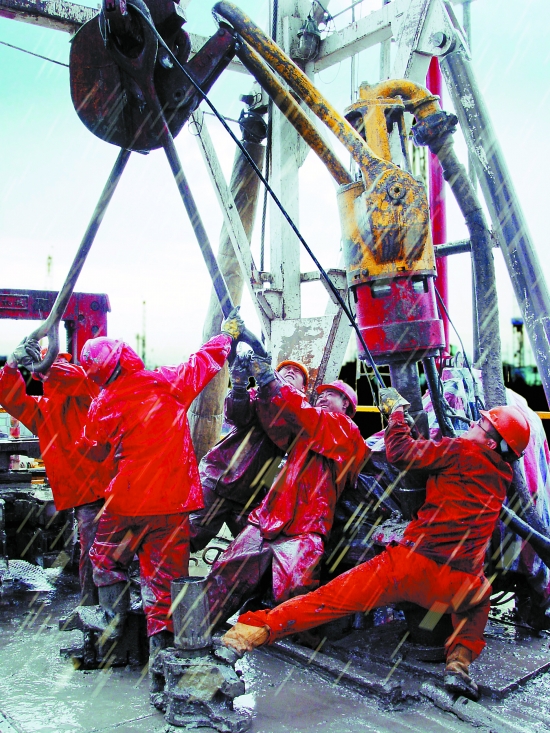
[Content] The spirit of pulling and carrying by human strength, the spirit of rammed-earth construction, the spirit of making revolution with five shovels, the spirit of the mending factory, the spirit of the recovery team and the spirit of repairing old and using waste. These spirits are important content of Daqing's tradition of hard struggle and are called by the Daqing people the 'six family heirlooms' of hard struggle.
[Origin] In the Daqing petroleum battle and the oilfield development and construction that followed, the Daqing people carried forward the spirit of patriotism and, with the heroic bearing of 'when conditions permit we must go ahead; when conditions do not permit we must create the conditions and go ahead anyway', defied layer upon layer of difficulties and struggled hard, gradually forming the 'six family heirlooms' of hard struggle.
The spirit of rammed-earth construction is one of the 'six family heirlooms'. In the early 1960s the country lacked both oil and money. The battle force proposed putting the whole before the part, the state before the individual and production before living. To save funds, earth houses that the local people called rammed earth were built in a simple way with local materials to solve the problem of workers getting through the winter. From the minister down to the workers, men and women, old and young all turned out, and after work they rolled up their sleeves and dug earth, rammed it, carried water and mixed mud, made adobe bricks and plastered walls, building houses together. After 120 days and nights of hard work, 300,000 square meters of rammed-earth housing were completed across the oilfield. Reporting on the Daqing Oilfield, the People's Daily wrote: seeing the rammed-earth houses was like seeing the Yan'an cave dwellings of those years; coming to Daqing was like returning to Yan'an in the years of war.
The spirit of rammed-earth construction, together with the spirit of pulling and carrying by human strength, the spirit of making revolution with five shovels, the spirit of the mending factory, the spirit of the recovery team and the spirit of repairing old and using waste, became the 'six family heirlooms' of hard struggle of the Daqing Oilfield.
[Significance] The 'six family heirlooms' of hard struggle have always inspired the Daqing people to tenaciously overcome the new difficulties that keep arising in the production process. The spirit of hard struggle and of diligence and thrift they embody must still be carried on and promoted in the new historical period.
Classic Stories
Carrying Water to Keep Drilling Going
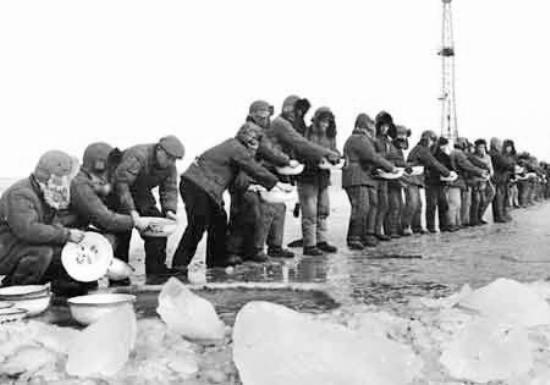
The first well drilled by team 1205, well Sa 55, was about to spud in. But there was no water pipeline; how was water for drilling to be found? Wang Jinxi held a whole-team mobilization meeting to get everyone thinking of a solution. At the meeting he first asked Xu Wanming: 'Drilling is about to start and there is no water; what shall we do?' This Xu Wanming, nicknamed the 'little tiger', was exceptionally clever and full of ideas. He thought for a moment and said: 'Carry water in basins to drill the well!' Jiang Ruxue beside him laughed and said: 'Have you ever seen any country drill a well by carrying water in basins? That is simply nonsense.' Wang Jinxi picked up the thread and said decisively: 'Xu Wanming's idea is good. If we can haul and carry the rig into place by human strength, we can carry water in washbasins to keep drilling going! Tomorrow we will drill the well by carrying water in basins.'
The next day, under Captain Wang's leadership, some carried basins, some carried buckets and some carried teapots... Everyone formed a long line, carrying water from the well and pouring it into the mud pit.
The water well they had dug themselves was soon emptied, and the villagers' well was nearly emptied too. Dai Zhuwen hurried to find Wang Jinxi: 'Captain Wang, if we empty the villagers' well, what will they drink and what will their livestock drink?' Captain Wang pointed to the west and said: 'Then we will go and carry water from the pond over there.'
More than a li west of the well site there was a large pond covered with a thick layer of ice. So everyone broke the ice to get water, basin after basin and bucket after bucket... A day passed and it was still far from enough water for drilling. Wang Jinxi thought that carrying water this way was inefficient, with all the time wasted on the road. After consulting everyone he decided to dig a ditch from the pond to the mud pit, carrying water out of the pond and pouring it into the ditch to let it flow into the mud pit.
Everyone quickly dug a small ditch, and indeed the efficiency of carrying water greatly improved. In four or five days the mud pit was full, with about 40 tons of water in all, guaranteeing the needs of drilling.
Measuring Temperature Across a Thousand Miles
In the early days of the battle, the crude oil produced by the Daqing Oilfield was transported out by railway tank cars. Daqing is a severely cold region and its crude oil has a high pour point, so in order to ship the crude oil out it had to be heated at the oil depot. If the heating temperature was not high enough, the crude oil would solidify on the way and freeze in the tank; if the heating temperature was too high, it would cause great waste.
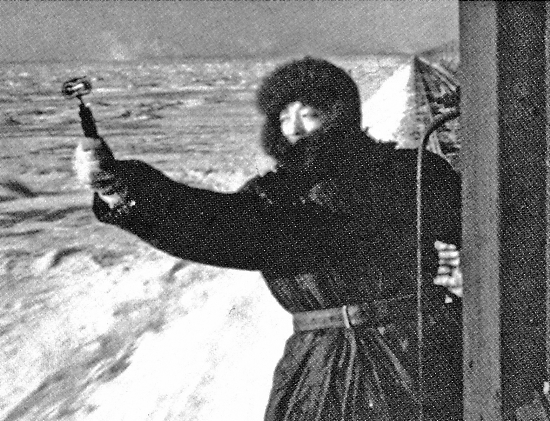
In order to clarify the oil temperature of Daqing crude oil in long-distance transport and the changes in wind speed and air temperature along the route, and to provide more scientific design data for heating the crude oil, Cai Sheng, an assistant technician at the Daqing Oilfield Design Institute, and Zhang Kongfa, a trainee, carried an anemometer, more than a dozen thermometers and a little dry food every day and climbed onto the crude tank trains, travelling continuously through severe cold, wind and snow for more than three months, making five round trips between Daqing and Dalian and covering more than 10,000 kilometers, gaining a large amount of first-hand data.
During those three months they once walked more than two hours in the dark on a cold night to measure the first data after the oil transport valve was opened. They lived on trains with no seats and no heating, gnawing a corn cake when hungry and drinking a few mouthfuls of cold water when thirsty, facing the cold wind and pressing on with the measurement work without hesitation. They modified crude temperature measuring equipment to measure several sets of data at the same time. Every hour they would hold the carriage handrail with one hand and grip the anemometer or thermometer with the other, leaning out from the speeding carriage, and in raging wind and snow and in freezing cold, from measurements that put their lives at risk, they captured more than 2,800 scientific data items such as oil temperatures and wind speeds, grasping on the spot the laws of oil temperature change in transport, obtaining a scientific design basis and saving the state a great deal of money.
Rather Have One That Stands the Test Than Ninety-Nine That Just Get By
In the early days of the Daqing battle, Zhou Zhan'ao and the No. 11 squadron of Daqing Oilfield Construction, to which he belonged, threw themselves wholeheartedly into oilfield development work in order to cast off China's label of being oil-poor and backward. To raise the standard of construction and the quality of the works he was strict to the point of a needle tip and meticulous to the breadth of a hair, and he proposed: 'Rather have one that stands the test than ninety-nine that just get by.'
One day Zhou Zhan'ao came to a well row where he had previously worked to see whether there were any problems after production began. When he checked the paraffin removal device he found a few drops of oil on the insulation sleeve of the paraffin removal rod, one of them at the weld. One or two drops of oil on well site equipment was hardly surprising. But that one drop raised a question in Zhou Zhan'ao's mind: was it splashed when the oil was blown off, or was there some other reason?
On the way home Zhou Zhan'ao kept turning it over in his mind and could not set his mind at ease about that drop of oil. Two days later he made a special trip to that well again. This time he saw that the insulation sleeve of the paraffin removal rod was already clean, only that there seemed to have been oil at the weld. Unwilling to let it go, he sought out the oil production worker on duty and asked in detail about how the well equipment had been operating recently; the worker told him that no problem had been found. The question Zhou Zhan'ao wanted to settle still had no answer.
At night Zhou Zhan'ao tossed and turned and could not sleep soundly. 'No, I must go and look again; there is definitely a problem!' Zhou Zhan'ao came to the well for the third time and at the suspected weld on the insulation sleeve of the paraffin removal rod he found another drop of oil the size of a grain of millet. Drawing on years of experience, Zhou Zhan'ao concluded that this was a pinhole formed at the weld when cold air entered during welding. If this hidden danger were not removed promptly it would bring serious consequences for production. Zhou Zhan'ao immediately sent for an engineering vehicle and patched the pinhole in good time. (All pictures on this page provided by the Daqing reporter station)