Minyak Motor Sintetik Sepenuhnya
  Minyak Enjin Diesel
  Minyak gear
  Minyak Motosikal
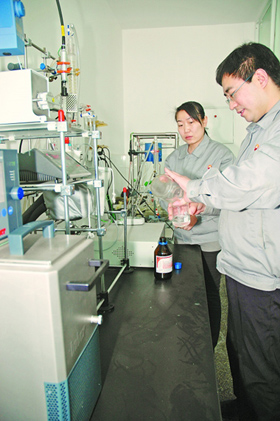
 Research and testing
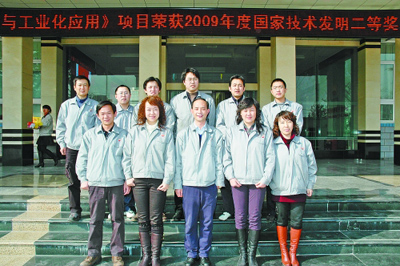
R&D team
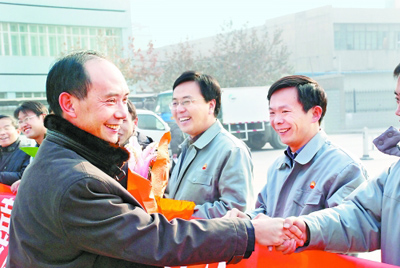
Returning with honors
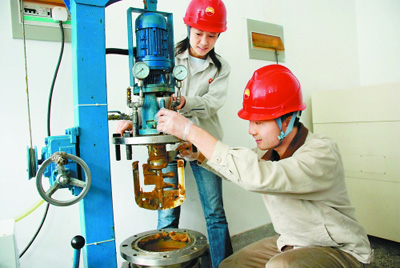
Compounding tests
For Fu Xisheng, this scene is engraved in his memory: on January 11, 2010, in the majestic Great Hall of the People, the 2009 National Science and Technology Awards Conference was being held grandly. Hu Jintao and other Party and state leaders presented award certificates to the winners. In an instant, camera flashes glittered and applause thundered.
On behalf of the R&D team of PetroChina's Lanzhou Lubricant Research and Development Center, Fu Xisheng held the certificate for the second prize of the National Technology Invention Award for Preparation Technology and Industrial Application of Extreme Pressure Anti-Wear Additives and Packages for Gear Oils, listening to Premier Wen Jiabao's earnest words: 'We must make the most of the situation, catch up with vigor, walk in the front of the wave of the world's new scientific and technological revolution, and push our country's economic development onto the track of innovation-driven and endogenous growth as soon as possible.'
The Premier's words inspired Fu Xisheng, because what he held was the first National Science and Technology Invention Award ever won in China's lubricant field. This award not only represents Kunlun Lubricant's achievements in independent intellectual property rights but also proves that China's lubricants have moved from made in China to created in China.
This technology includes 4 independently researched and created single additives with defined chemical molecular structures. Among them, the extreme pressure anti-wear single additive completed bench limit tests at the Southwest Research Institute in the United States, the world's most authoritative institution in this field, and received the highest grade rating, proving that its performance far exceeds similar foreign products.
With these technologies, Kunlun gear oil passed 100,000-kilometer road tests without oil changes at Dongfeng Motor and FAW Changchun, proving it not only resists wear but also saves fuel, showing unique advantages under local conditions of overloading, complex roads and harsh weather. With these technologies, Kunlun gear oil passed rigorous tests by the General Armaments Department of the People's Liberation Army and was designated as the dedicated gear oil for the military. With these technologies, Kunlun gear oil is contributing to the booming high-speed rail sector.
These technologies broke the foreign monopoly, cutting the import price of lubricant additives from 49,800 yuan per ton by half. These technologies were hard won; they spanned more than 30 years and embody the painstaking efforts of several generations of researchers.
We must have our own lubricant technology
Why are well-known multinational oil companies so keen on building up their own lubricant brands? Zhao Chongzhi, an expert in China's lubricant industry, put it bluntly: 'Gasoline and diesel are general technologies that cannot be compared on superiority, but lubricants each have their own proprietary technologies. This shows the technological content of each company, and it is the stepping stone to opening the door to the market.'
China's lubricant additive technology research has gone through a long and tortuous process.
Gear oil is a lubricant variety with a very wide range of applications; wherever there is gear transmission, lubrication is needed. Especially in the military field, without lubricants with independent intellectual property rights one can only be passive. Therefore, from the very founding of New China, the state organized scientific and technological research.
Faced with a situation of complete poverty and blankness, New China once used asphalt as a substitute for industrial gear lubrication. Starting in the 1950s, the first generation of New China's lubricant science and technology workers, at what was then the Refining Research Institute of the Lanzhou Refinery under the Ministry of Petroleum (the predecessor of the Lanzhou Lubricant R&D Center), began China's lubricant technology research with chlorinated paraffin.
Conditions were hard and equipment rudimentary, but with the painstaking efforts and sweat of researchers in Lanzhou, Beijing and elsewhere, the needs of New China for mechanical transmission lubricants were met step by step.
Lubricants were the earliest market liberalized after China's reform and opening up. Hit by foreign oil and by continuous restructuring and reform, in the 1970s and 1980s lubricant research institutions that had reached a certain R&D scale, such as those in Shanghai and Jingmen attached to refineries, were abolished one after another. Foreign oil dominated the Chinese market. China's lubricant research institutions were reduced to just two R&D centers under PetroChina, in Lanzhou and Dalian, and one research institute under Sinopec.
Gear oil, accounting for about 10 percent of the lubricant family, is the flagship product with the highest technological content among lubricants, and has been the key research focus of PetroChina's lubricant researchers for many years. Researchers at the Lanzhou R&D Center say that the core technology of gear oil additives is the synthesis and compounding technology of phosphorus-containing anti-wear additives. Foreign companies keep this technology strictly confidential; they neither sell products nor provide any information about such products, imposing a comprehensive technology blockade.
It is precisely through perseverance that China's lubricant industry has held its ground in technology research and gained a voice in the world lubricant field.
Searching among dull chemical molecular structures
Where does the technological content of lubricants lie? Researchers at the Lanzhou R&D Center told reporters: in the chemical molecular structures. For a lubricant to achieve cooling, anti-wear and fuel-saving requirements, its molecular structure must be changed and its properties altered through additives to meet the relevant requirements.
Starting with the Seventh Five-Year Plan, the state included the research and development of gear oil additives in its scientific and technological research programs. In 1987, Fu Xisheng graduated from Lanzhou University's chemistry department with a major in organic synthesis and was assigned as an assistant to the research team led by Kuang Yijiu. By the time of the Eighth Five-Year Plan, Fu Xisheng had taken over as team leader. Although he worked in basic research for more than 20 years, he says he was very fortunate, because the achievement that won the second prize of the National Technology Invention Award was built on the shoulders of predecessors.
From the time the project was included in national research programs, earlier researchers in the team began screening and synthesizing from more than 10,000 chemical molecular structures. In the words of the researchers, it was like fishing a needle from the ocean. Through solitude and repeated failures they gradually narrowed the scope of synthesis. By the start of the Eighth Five-Year Plan, Kuang Yijiu and other veteran science and technology workers had left Fu Xisheng with only 200 of the most promising molecular structures.
Speaking of dealing with all kinds of chemical reagents in the laboratory, the researchers on Fu Xisheng's team who grew from their twenties into their thirties and forties have many deep impressions.
Xu Jing, a female master's graduate of the Lanzhou Institute of Chemical Physics and one of the main researchers for the second prize of the National Technology Invention Award, took part in and completed the preparation, performance research and application work for phosphate esters, acidic thiophosphate amine salts, thiophosphate complex ester amine salt additives, gear oil additive packages and gear lubricants. At that time laboratory equipment was rudimentary, and while synthesizing phosphorus-containing agents she was pregnant, often having to scoop up toxic chemicals with her hands. She said: 'At the time I was really worried my child might have some disability, but now he studies quite well.'
Mi Liping, a graduate of Jiangsu Institute of Chemical Technology, took part as a main researcher in the invention of the RHY4208 package and the phosphorus-containing extreme pressure anti-wear additives used in it. For her, the most memorable part was lubricant blending. Base oil came in 180-kilogram drums, and men and women alike had to roll them down and push them in, then weigh the oil and pour it into the blending kettle.
A test takes more than ten hours from reaction to product and cannot be interrupted. During the most critical periods, Fu Xisheng would stay in the laboratory for days on end, lying down on the workbench for a while when he was truly exhausted.
It was precisely through dedication and perseverance in this remote mountain valley and isolated environment, and after unremitting efforts and countless failures, that Fu Xisheng and his research team found the right route and finally synthesized and invented four extreme pressure anti-wear additives with different chemical composition structures: phosphorus-containing, sulfur-phosphorus, sulfur-phosphorus-nitrogen, and sulfur-phosphorus-nitrogen-boron. After compounding these single additives, they invented a series of gear oil additive packages with better performance than similar packages at home and abroad.
At last, China's Kunlun gear oil saw the dawn of the world's most advanced lubricants.
Independent innovation comprehensively upgrades Kunlun Lubricant
The successful development of the phosphorus-containing anti-wear additive was only the first step in a long march. Next, the researchers carried out compounding research on the additives and application tests of the packages in oils. Through research on the molecular structure design, synthesis, preparation and performance of additives, friction, wear and tribochemical mechanisms, and the compounding effects of extreme pressure anti-wear additives, they developed new types of gear lubricant additives, achieving balance and unity in gear oil formulations.
After years of arduous research, the four distinctive phosphorus-containing anti-wear additives respectively solved issues of gear oil universality, cleanliness, long life, anti-wear and energy saving, and China's first sulfur-phosphorus type universal gear oil package LAN4201 and its first manual transmission oil package RHY4161 were born at their hands. These achievements not only filled domestic gaps; the RHY4163 package also obtained a US patent, breaking the foreign monopoly, forcing substantial price cuts in similar foreign products and bringing Chinese gear oil to internationally advanced levels.
Mastery of the project Preparation Technology and Industrial Application of Extreme Pressure Anti-Wear Additives and Packages for Gear Oils has allowed research and development to advance through continuous innovation and improvement. The researchers successively invented a variety of new phosphorus-containing anti-wear agents and gear oil packages.
RHY4208 is a complete set of technology with independent intellectual property rights. It is an environmentally friendly, energy-saving, long-life product that fully reaches the international leading level. Its cost-performance ratio is better than similar foreign products, and it has been recognized by companies such as FAW, Dongfeng Motor, BAIC Foton and Jinan Heavy Duty Truck, giving it strong market competitiveness.
Compared with similar products at home and abroad, the packages they invented have six unique features: high extreme pressure performance and no corrosion; resistance to pitting and spalling with no wear; outstanding extreme pressure anti-wear durability; no metals and no chlorine, environmentally clean, miscible with any gear oil and with excellent storage stability; excellent water resistance and anti-foam performance; and compatibility with all sealing materials used in automobiles. These features thoroughly solved the problem of domestic production of Chinese gear oil additives, obtaining 1 US invention patent and 10 Chinese invention patents and achieving large-scale market application. Through 12 years of industrial application, the project has formed 12 enterprise standards and 5 production specifications.
The gear oil series lubricants produced with the invention Preparation Technology and Industrial Application of Extreme Pressure Anti-Wear Additives and Packages for Gear Oils have been produced on a large scale at the lubricant plants under PetroChina Lubricant Company. The technical level and cost-performance of the products equal and in part exceed similar international products, and they have been successfully applied in the automotive industry and in military equipment. In particular, the multi-effect gear oil blended with this invention was certified by the General Armaments Department of the People's Liberation Army as the only designated oil for equipment related to the 2009 National Day military parade. From 2006 to 2008, a total of 15,637 tons of gear oil additives and 221,051 tons of gear oil were produced, with an output value of 3.29 billion yuan and economic benefits of 450 million yuan.
Fu Xisheng has a motto: 'If you do it, do the best.' He and his team are continually striving toward the most advanced lubricant technologies.
Expert evaluations
Li Zhigang, chief power transmission expert of the General Armaments Department of the People's Liberation Army: the project on synthesis, preparation and application of gear lubricant additives has achieved a number of important innovative results and invented packages at internationally advanced levels, such as the LAN4204, RHY4208 and RHY4163 gear lubricant additive packages, which passed 800-hour bench tests and 240,000-kilometer road tests, with product performance and practical application results exceeding similar foreign products.
Zhao Chongzhi, a veteran lubricant expert: this is genuine creation. Five chemical single additives were invented, and through compounding an internationally leading additive was obtained. The research work obtained 10 Chinese invention patents and 1 US patent. The lubricant additives and gear lubricants developed and invented have been produced on a large scale and successfully applied in the automotive, steel, cement and wind power industries as well as in military equipment, generating enormous economic benefits. The project results have to a large extent changed the situation in which China's high-performance lubricant additives and high-grade lubricants long depended on imports, met the demand of certain important industrial and military fields and high-tech industries for high-quality lubricant products, and achieved energy saving and consumption reduction through lubrication, with obvious social benefits.