Volledig synthetische motorolie
  Dieselmotorolie
  Versnellingsbakolie
  Motorolie
 Foreword:
This white paper, starting from the concerns of automakers and consumers and in view of the performance requirements of passenger vehicle engine oils in terms of energy saving, detergency, wear and turbocharger protection, conducts comparative tests between Kunlun lubricating oils and the factory-fill service oils of some of the vehicle models competing in the 2018 China Car Performance Competition at the same quality and viscosity grade, providing important test data for automakers and consumers to gain an in-depth understanding of the performance of engine oils in use.
1. Test oils
Based on the vehicle models competing in the 2018 China Car Performance Competition (hereafter the 2018 CCPC), the organising committee selected six representative models for comparative oil performance testing. The test oils were the factory-fill service oil and Kunlun lubricating oils of equivalent grade, KR9-T and KR9 gasoline engine oils. The selected vehicles and oil information are shown in Table 1.
Table 1 Vehicle information and test engine oils
No.
Vehicle parameters
Factory-fill service oil
Kunlun lubricating oil
Car 1
Sedan
1.4T dual-clutch turbocharged engine
SN 5W-40
SN 5W-40
Car 2
SUV
1.5T automatic manual turbocharged engine
SN 5W-40
Car 3
SUV
1.6L manual naturally aspirated engine
SN 5W-30
SN 5W-30
Car 4
SUV
2.0T dual-clutch turbocharged engine
SN 5W-30
Car 5
Sedan
1.6T dual-clutch turbocharged engine
SN 5W-20
SN 5W-20
Car 6
SUV
1.5T automatic manual turbocharged engine
SN 0W-20
SN 0W-20
2. Test methods
This comparative oil performance testing combined a variety of test methods and testing means, including not only basic physical and chemical tests and simulation tests but also on-vehicle performance testing. In accordance with the Rules of the 2018 China Car Performance Competition (hereafter the 2018 CCPC Rules), the test methods all adopted or referred to international, national and industry standards for the lubricant industry. The test items, test methods and testing bases are shown in Table 2.
Table 2 Test items, test methods and testing bases
Test item
Test method
Testing basis
Physical and chemical tests
Kinematic viscosity
Determination of kinematic viscosity of petroleum products and calculation of dynamic viscosity
GB/T 265
High-temperature high-shear viscosity
Determination of apparent viscosity of lubricants under high-temperature high-shear rate conditions (multiple capillary viscometer method)
SH/T 0703
Low-temperature dynamic viscosity
Determination of apparent viscosity of engine oils (cold cranking simulator method)
GB/T 6538
Borderline pumping viscosity
Determination of yield stress and apparent viscosity of engine oils at low temperature
SH/T 0562
Simulation tests
SRV friction and wear
Determination of friction and wear performance of extreme-pressure lubricants
NB/SH/T 0847
High-temperature deposits
Determination of high-temperature oxidation deposits of engine oils
SH/T 0750
Oxidation induction period
Dynamic micro-oxidation test method for internal combustion engine oils
In-house method
Stribeck curve
Traction coefficient method using a micro-traction machine
In-house method
Low-temperature sludge
Low-temperature dispersancy oxidation and nitration reaction method
In-house method
Low-temperature fluidity
Low-temperature fluidity test under the 2018 CCPC Rules
In-house method
On-vehicle tests
Fuel consumption per 100 km
Fuel consumption test under the 2018 CCPC Rules
With reference to GB/12545
Low-temperature cold start
Cold-start test under the 2018 CCPC Rules
With reference to GB/T12535
0-60 km standing-start acceleration
Standing-start acceleration test under the 2018 CCPC Rules
With reference to GB/T12543
0-100 km standing-start acceleration
Standing-start acceleration test under the 2018 CCPC Rules
With reference to GB/T12543
Idle noise test
Idle noise test under the 2018 CCPC Rules
With reference to GB/T18697
Fuel dilution
Determination of diluted gasoline content in in-service gasoline engine oils by gas chromatography
With reference to NB/SH/T 0474
3. Physical and chemical tests
3.1 Kinematic viscosity
Kinematic viscosity at 100 degrees Celsius is one of the most basic quality indicators of engine oil. Understanding lubricant viscosity and the factors affecting viscosity change is of great significance for correctly selecting lubricant products. The test results for the kinematic viscosity at 100 degrees Celsius of the factory-fill service oils and Kunlun lubricating oils are shown in Table 3.
Table 3 Kinematic viscosity of the oils at 100 degrees Celsius
Viscosity grade
SN 5W-40
No.
Standard (1)
Car 1
Car 2
Kunlun A
Kinematic viscosity at 100 degrees Celsius (mm2/s)
12.5 to less than 16.3
14.15
14.89
13.38
Viscosity grade
SN 5W-30
No.
Standard
Car 3
Car 4
Kunlun B
Kinematic viscosity at 100 degrees Celsius (mm2/s)
9.3 to less than 12.5
11.30
10.13
10.61
Viscosity grade
SN 5W-20
No.
Standard
Car 5
Kunlun C
Kinematic viscosity at 100 degrees Celsius (mm2/s)
5.6 to less than 9.3
8.58
8.38
Viscosity grade
SN 0W-20
No.
Standard
Car 6
Kunlun D
Kinematic viscosity at 100 degrees Celsius (mm2/s)
5.6 to less than 9.3
8.78
8.72
(1) SAE J300-2009 Engine Oil Viscosity Classification standard of the Society of Automotive Engineers.
The data in the table show that the viscosities of both the factory-fill service oils and the Kunlun lubricating oils meet the requirements of the SAE J300 standard and are essentially at the same level.
3.2 High-temperature high-shear viscosity
The service performance of engine oil is closely related to its viscosity under high-temperature and high-shear conditions. High-temperature high-shear viscosity refers to the viscosity value of a lubricant working under high engine temperature (150 degrees Celsius) and high shear, that is, the oil film strength under high-temperature high-shear conditions; it represents the index of a lubricant's viscosity stability under high-temperature high shear.
The test results for the high-temperature high-shear viscosity of the factory-fill service oils and Kunlun lubricating oils are shown in Table 4.
Table 4 High-temperature high-shear viscosity of the oils
Viscosity grade
SN 5W-40
No.
Standard
Car 1
Car 2
Kunlun A
High-temperature high-shear viscosity (mPa.s)
Not less than 3.5
3.86
4.00
4.2
Viscosity grade
SN 5W-30
No.
Standard
Car 3
Car 4
Kunlun B
High-temperature high-shear viscosity (mPa.s)
Not less than 2.9
3.26
3.15
3.2
Viscosity grade
SN 5W-20
No.
Standard
Car 5
Kunlun C
High-temperature high-shear viscosity (mPa.s)
Not less than 2.6
2.94
3.01
Viscosity grade
SN 0W-20
No.
Standard
Car 6
Kunlun D
High-temperature high-shear viscosity (mPa.s)
Not less than 2.6
2.66
2.74
The data in the table show that the high-temperature high-shear values of both the factory-fill service oils and the Kunlun lubricating oils meet the standard requirements. However, the high-temperature high-shear viscosity of the Kunlun lubricating oils is slightly higher than that of the factory-fill service oils, which in theory can provide better anti-wear protection under the same operating conditions.
3.3 Low-temperature dynamic viscosity
After a vehicle has been parked for a long time under low-temperature conditions, the engine is prone to difficult starting, increased fuel consumption and severe wear of parts, and may even fail to start at all. Under low-temperature conditions, one of the main reasons for difficult engine starting is the increase in lubricant viscosity. High lubricant viscosity means poor fluidity, which increases the rotational resistance of the engine crankshaft, reduces cranking speed and slows the gas flow rate in the intake manifold, so that the fuel is poorly atomised and the engine cannot start quickly. Therefore, the lower the low-temperature dynamic viscosity of an engine oil, the better its low-temperature starting performance.
The test results for the low-temperature dynamic viscosity of the factory-fill service oils and Kunlun lubricating oils are shown in Table 5.
Table 5 Low-temperature dynamic viscosity of the oils
Viscosity grade
SN 5W-40
No.
Standard
Car 1
Car 2
Kunlun A
Low-temperature dynamic viscosity (mPa.s)
Not more than 6600
5620
5720
5440
Viscosity grade
SN 5W-30
No.
Standard
Car 3
Car 4
Kunlun B
Low-temperature dynamic viscosity (mPa.s)
Not more than 6600
5740
5480
5370
Viscosity grade
SN 5W-20
No.
Standard
Car 5
Kunlun C
Low-temperature dynamic viscosity (mPa.s)
Not more than 6600
5350
5160
Viscosity grade
SN 0W-20
No.
Standard
Car 6
Kunlun D
Low-temperature dynamic viscosity (mPa.s)
Not more than 6200
4770
4620
The data in the table show that the low-temperature dynamic viscosities of both the factory-fill service oils and the Kunlun lubricating oils of the test vehicles meet the standard requirements. However, the Kunlun lubricating oils have lower low-temperature dynamic viscosity than the factory-fill service oils, which in theory can provide better low-temperature starting performance for vehicles in the same low-temperature starting environment.
3.4 Borderline pumping viscosity
According to statistics, engine wear occurs mainly during the cold-start stage, accounting for more than 75% of total engine wear. The engine starting process is very short, and if the lubricant cannot quickly reach all the moving parts of the engine, engine wear will be aggravated. The ability of a lubricant to be pumped to the various friction surfaces of the engine under low-temperature conditions is called low-temperature pumpability, and it is one of the important quality indicators of multigrade oils. The test results for the borderline pumping viscosity of the factory-fill service oils and Kunlun lubricating oils are shown in Table 6.
Table 6 Borderline pumping viscosity of the oils
Viscosity grade
SN 5W-40
No.
Standard
Car 1
Car 2
Kunlun A
Borderline pumping viscosity (mPa.s)
Not more than 60000
27500
25600
23800
Viscosity grade
SN 5W-30
No.
Standard
Car 3
Car 4
Kunlun B
Borderline pumping viscosity (mPa.s)
Not more than 60000
22900
21300
20200
Viscosity grade
SN 5W-20
No.
Standard
Car 5
Kunlun C
Borderline pumping viscosity (mPa.s)
Not more than 60000
12800
11600
SN 0W-20
No.
Standard
Car 6
Kunlun D
Borderline pumping viscosity (mPa.s)
Not more than 60000
12500
11200
The data in the table show that the borderline pumping viscosities of both the factory-fill service oils and the Kunlun lubricating oils meet the standard requirements, but the Kunlun lubricating oils have lower low-temperature pumping viscosity than the factory-fill service oils.
4. Simulation tests
4.1 High-temperature oxidation resistance
4.1.1 Dynamic micro-oxidation test for engine oils (CMOT method)
As an engine runs continuously, engine oil undergoes high-temperature oxidation; after oxidation it gradually darkens and thickens and loses its lubricating performance. High-quality lubricants generally have better oxidation resistance and high-temperature tolerance. This performance test uses the dynamic micro-oxidation test (CMOT method) to test the oxidation resistance of oils,
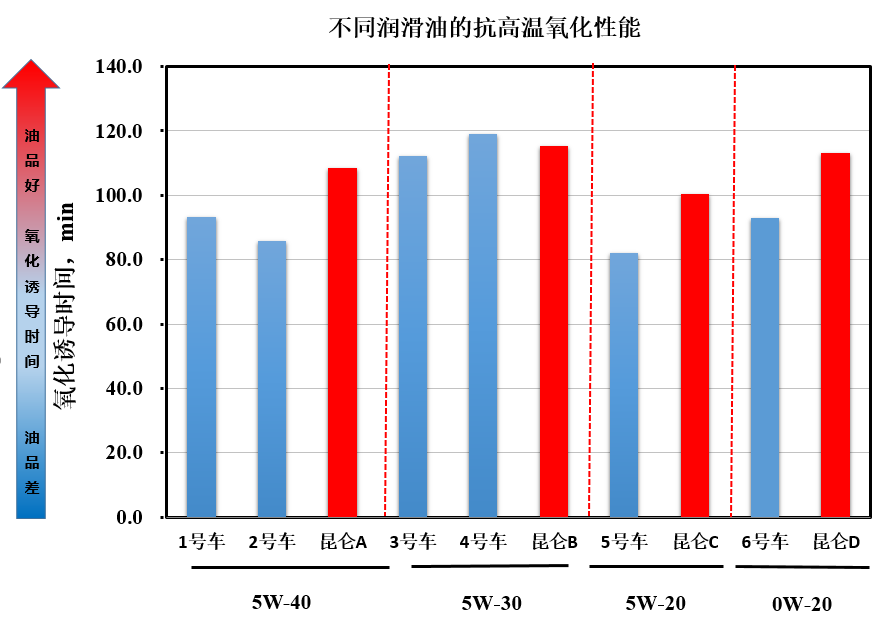
This method is mainly used to evaluate the oxidation stability and deposit-forming tendency of internal combustion engine oils, and evaluates the antioxidant performance of an oil by measuring its oxidation induction period. The longer the oxidation induction period, the better the oil's antioxidant capacity.
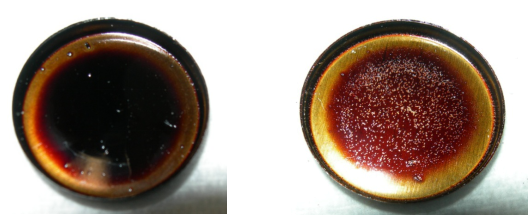
Figure 1 shows a comparison of two different oils after oxidation in the CMOT test. Oil with poor oxidation resistance forms darker deposits after oxidation.
Figure 1 Comparison of two different oils after the CMOT test
The dynamic micro-oxidation test results for the factory-fill service oils and Kunlun lubricating oils are shown in Figure 2.
Figure 2 Oxidation induction time of the oils
The data in Figure 2 above show that, compared with the factory-fill service oils, Kunlun lubricating oils have a longer oxidation induction time and better oxidation resistance and high-temperature tolerance, and can maintain excellent lubrication and detergency in high-temperature environments, safeguarding vehicles on the road.
4.1.2 Thermal oxidation simulation test for engine oils (TEOST 33C method)
With the widespread use of turbocharged engines, oil protection of the turbocharger is particularly important. The engine oil thermal oxidation simulation test machine (TEOST 33C method) was used to test the oil's ability to control turbocharger deposits. Engine oils with excellent performance can effectively reduce the generation of turbocharger deposits, keeping the turbocharger running healthily and smoothly to increase engine power and extend turbocharger life.
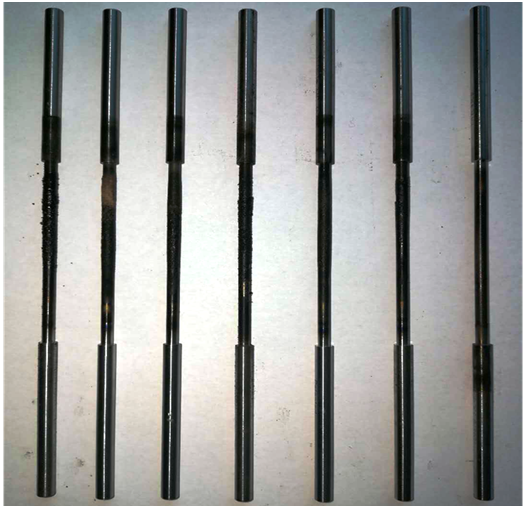
Figure 3 shows examples of deposits formed on test pieces by different test oils in the TEOST 33C test. Oils with excellent performance form fewer deposits on the deposit rod.
Figure 3 Test pieces showing deposits formed by different oils
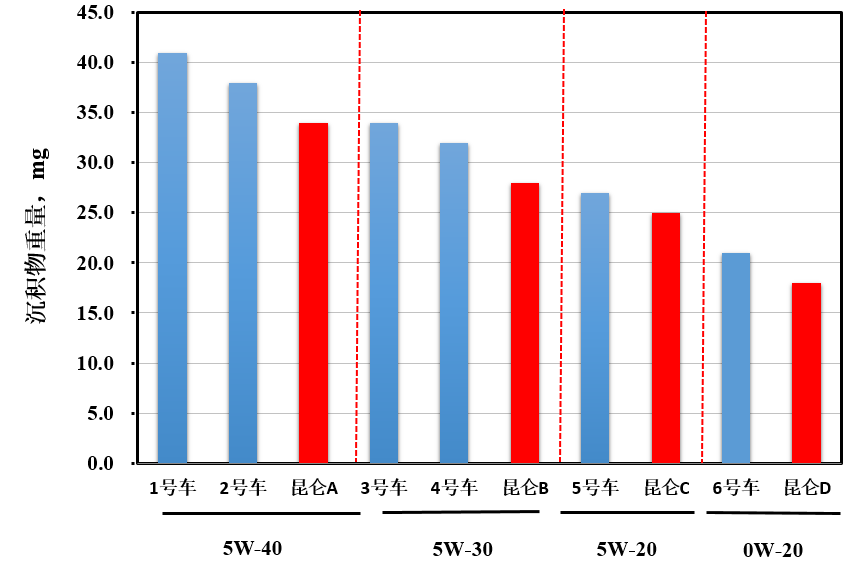
The TEOST 33C test results for the factory-fill service oils and Kunlun lubricating oils are shown in Figure 4.
Figure 4 Mass of deposits formed by the oils on the test pieces
The comparison in the figure above shows that, compared with factory-fill service oils of the same viscosity grade, Kunlun lubricating oils reduced high-temperature deposits by 42%-63%. Kunlun lubricating oils can therefore effectively inhibit the formation of turbocharger deposits at high temperature and extend the service life of the turbocharger.
4.2 Engine oil friction coefficient test (MTM method)
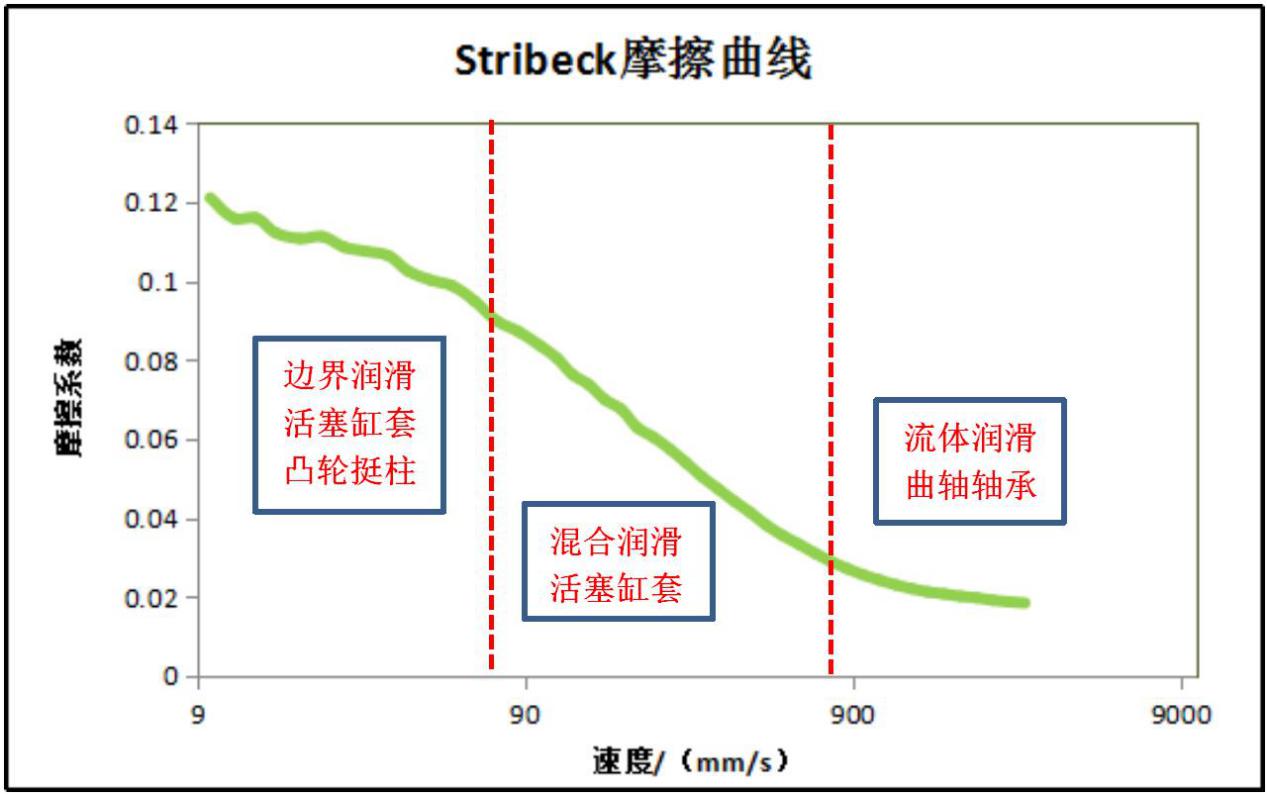
The laboratory used an MTM test machine to simulate the lubrication states of the engine's three main friction pairs (cam-tappet, piston-cylinder liner and crankshaft sliding bearing), that is, the Stribeck curve. The friction-reducing effect of the oil on the engine's various parts was tested, thereby reflecting the energy-saving effect of the oil.
Figure 5 shows the lubrication states represented by different rotational speeds in the MTM curve.
Figure 5 Lubrication states represented by different rotational speeds
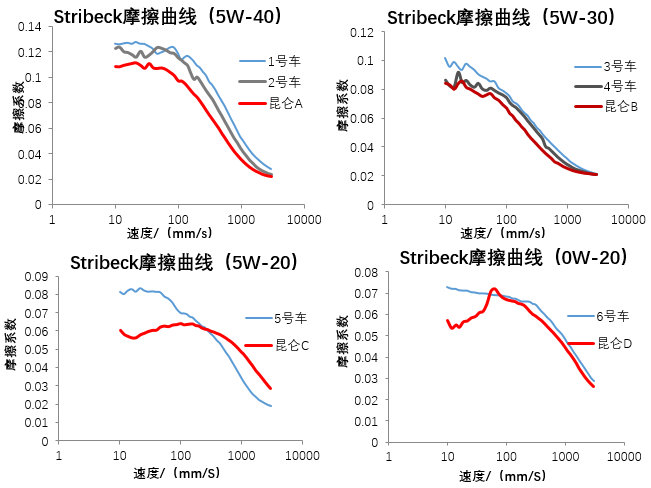
The MTM test results for the factory-fill service oils and Kunlun lubricating oils are shown in Figure 6.
Figure 6 Stribeck friction curves of different oils
Figure 6 shows that, compared with the factory-fill service oils, Kunlun lubricating oils have a lower friction coefficient under boundary lubrication conditions and can effectively reduce the friction power loss of the piston-cylinder liner and valve train. They therefore deliver a good energy-saving effect and improve the fuel economy of the whole vehicle.
4.3 Low-temperature sludge dispersancy test
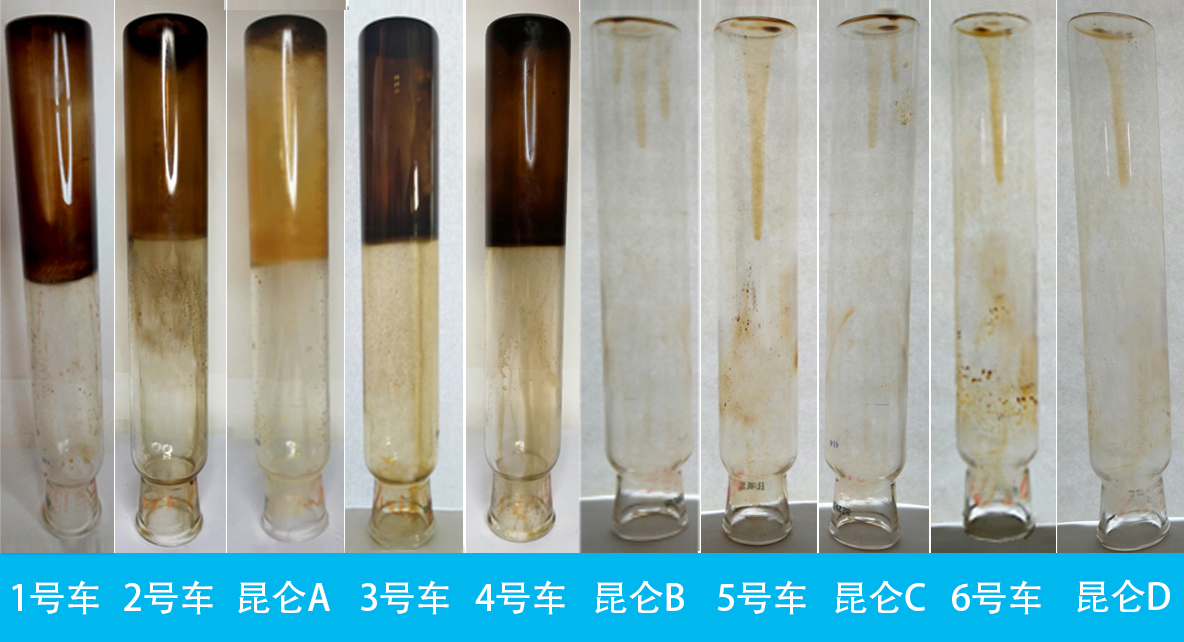
Driving a car in the city with frequent stop-and-go operation easily produces sludge, which accelerates the ageing of the lubricant, blocks oil passages and harms the engine. A low-temperature sludge test machine was used to simulate how much sludge the lubricant generates during engine operation, so as to evaluate the low-temperature sludge dispersancy of engine oils. Engine oils with excellent performance can disperse sludge better and provide better detergency protection for the engine.
The low-temperature sludge test results for the factory-fill service oils and Kunlun lubricating oils are shown in Figure 7.
Figure 7 Low-temperature sludge test results for different oils
Figure 7 shows that, compared with factory-fill service oils of the same grade, Kunlun lubricating oils generate less sludge in the test tube and have better low-temperature sludge dispersancy. Kunlun lubricating oils can therefore more effectively inhibit sludge formation in engine oil and provide better detergency protection for the engine.
4.4 Engine oil friction and wear test (SRV method)
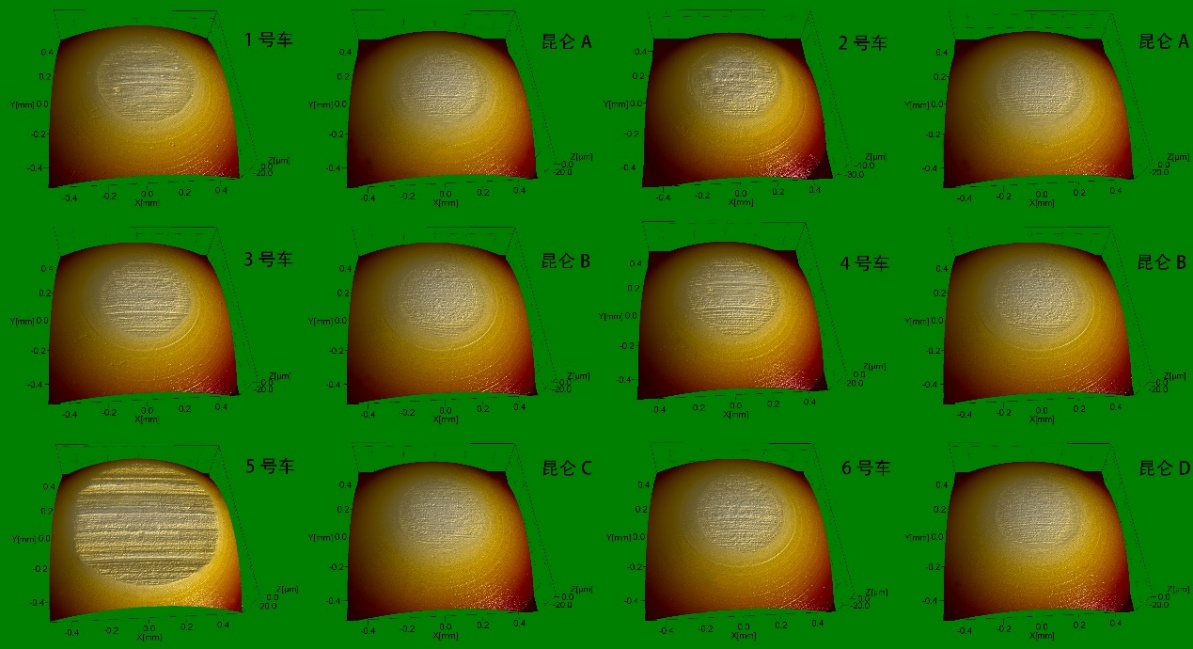
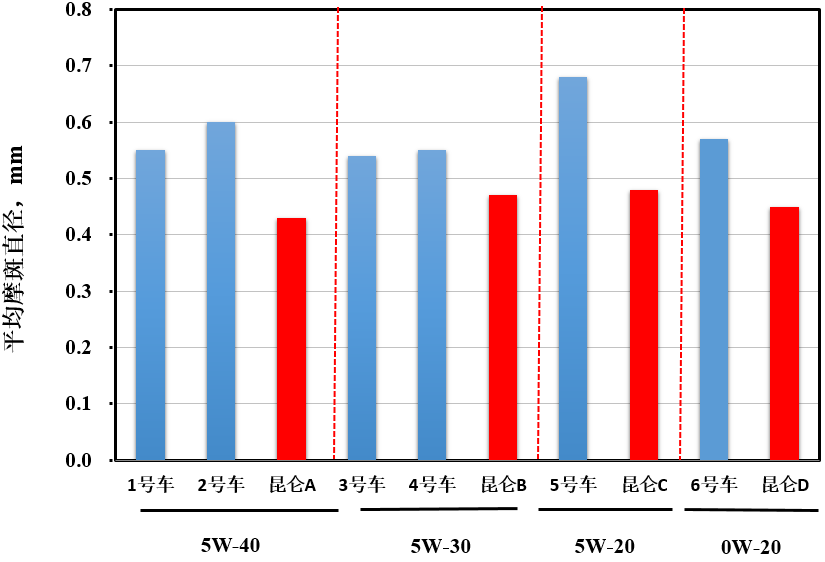
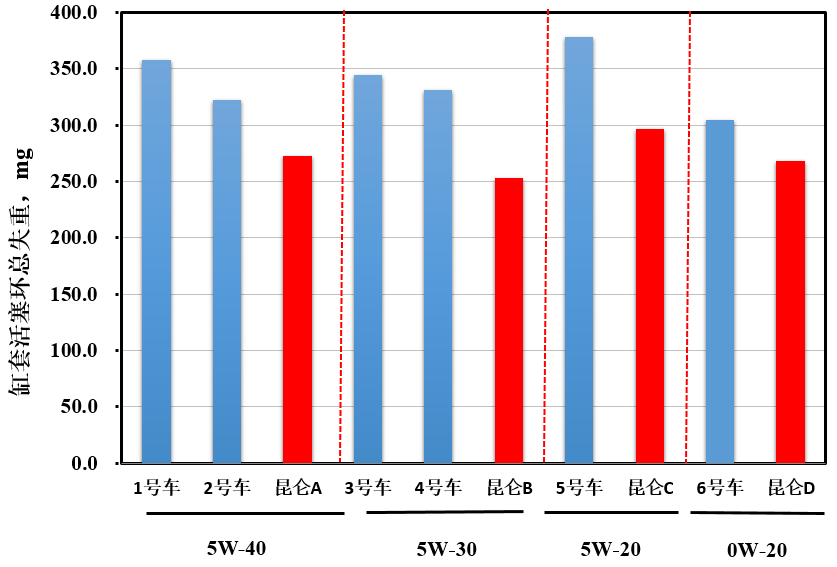
Any moving mechanical part is subject to wear, and engine oils with good anti-wear performance can effectively reduce wear of engine components and thereby extend engine service life. On an SRV friction and wear test machine, a ball-on-disc friction pair and a real engine cylinder liner-piston ring friction pair were used to test the anti-wear performance of different engine oils. In the SRV ball-on-disc friction pair, the smaller the wear scar diameter of the steel ball, the better the anti-wear performance of the lubricant; in the cylinder liner-piston ring friction pair, the smaller the weight loss of the cylinder liner, the better the anti-wear performance of the lubricant
The SRV friction and wear test results for the factory-fill service oils and Kunlun lubricating oils are shown in Figures 8, 9 and 10.
Figure 8 Three-dimensional topography of SRV steel balls after testing with different oils
Figure 9 Average wear scar diameter of steel balls after SRV testing with different oils
Figure 10 Cylinder liner weight loss after SRV testing with different oils
From observing the three-dimensional topography of the test steel balls and the bar chart of cylinder liner wear weight loss, it can be seen that, among oils of the same viscosity grade, Kunlun lubricating oils have a smaller average wear scar diameter and smaller cylinder liner weight loss than the factory-fill service oils. Kunlun lubricating oils can therefore effectively reduce wear of key engine components and provide excellent wear protection for the engine.
4.5 Low-temperature fluidity test
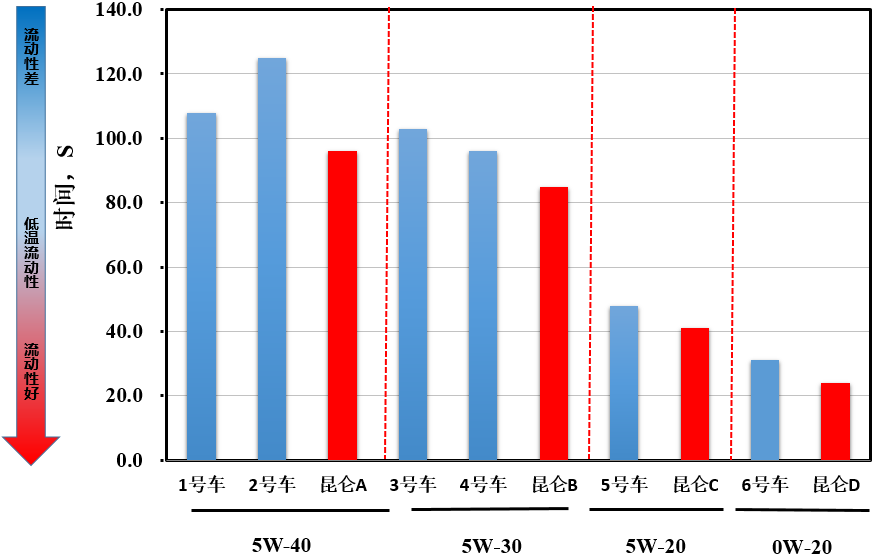
The low-temperature fluidity of an oil is related to two major physical and chemical properties of the lubricant: low-temperature dynamic viscosity and borderline pumping viscosity. The smaller these two values, the better the low-temperature fluidity and cold-start capability of the oil.
The specific test method was as follows: in accordance with the Competition Rules, an oil quality comparison instrument was used on December 9 in Yakeshi to add the factory-fill service oil and the Kunlun oil respectively, followed by 15 hours of outdoor immersion, with an average outdoor temperature of -27 degrees Celsius. Taking the time for the steel ball in the oil quality comparison instrument to fall to the bottom as the benchmark, the faster the oil fell, the better its low-temperature fluidity. The low-temperature fluidity results are shown in Figure 11.
Figure 11 Low-temperature fluidity of different oils
The results in the figure above show that, compared with the factory-fill service oils, Kunlun lubricating oils have better low-temperature fluidity, which corresponds to the two basic properties of the oils in the earlier physical and chemical tests: low-temperature dynamic viscosity and borderline pumping viscosity.
5. On-vehicle performance tests
5.1 Fuel economy test
In a plateau environment, because atmospheric pressure and the oxygen content of the air decrease, the temperature and pressure at the end of cylinder compression drop, the combustible gas in the cylinder burns incompletely, engine power declines and fuel consumption increases.
The fuel economy test was carried out in accordance with the Competition Rules and with reference to national standard GB/12545. The test used a combined urban and rural operating condition, with an average vehicle speed of 85 km/h and a driving distance of about 150 km.
The fuel consumption test method was as follows: refuelling was carried out by test site staff in the same time period, at the same petrol station and with the same fuel nozzle for the same vehicle group, filling each vehicle to the limit position of the filler neck. After the test, each vehicle was refuelled to its initial state; the amount of fuel dispensed by the fuel dispenser after the test is the amount of fuel consumed by each vehicle during the test, based on the dispenser reading. The fuel economy test conditions and results are shown in Table 7.
Table 7 Kunlun Lubricant Cup - 2018 China Car Performance Competition fuel economy test record sheet
Test date: October 2018
Test location: Jialize, Songming, Kunming
Road surface: hard-surfaced road
Weather: clear
Air temperature: about 22 degrees Celsius
Wind speed: 6 m/s
Test vehicle information
Fuel consumption at a constant speed of 85 km/h (L)
Driving distance about 150 km
Type of oil
Test vehicle
Total vehicle mileage
(km)
Factory oil result (L)
Kunlun lubricating oil
Result (L)
Fuel saving rate
%
Test location
Car 1
822 km
9.07
8.39
7.50
Combined urban and rural road conditions, Jialize, Songming, Kunming
Car 2
835 km
10.42
10.05
3.55
Car 3
878 km
11.61
11.07
4.65
Car 4
845 km
11.96
11.34
5.18
Car 5
923 km
10.39
9.7
6.64
Car 6
931 km
10.79
10.35
4.08
By comparing the fuel data for the factory-fill service oils and for the vehicles after being filled with Kunlun lubricating oils, it can be seen that most vehicles showed a certain improvement in fuel economy after being filled with Kunlun oil, with an average fuel saving rate of 5.27%.
5.2 0-100 km/h standing-start acceleration test
The 0-100 km/h standing-start acceleration test was carried out in accordance with the Competition Rules and with reference to national standard GB/12543-1990.
On October 20 and 21 the test vehicles were filled with the factory oil and Kunlun oil respectively, and each test vehicle carried out 0-100 km/h acceleration tests on a hard-surfaced road, with six runs per vehicle and the average acceleration time recorded.
The specific test method was as follows: after refuelling to full, the vehicle drove to the same hard-surfaced road and carried out a standing-start 0-100 km/h acceleration test on that same road surface, using the YT1500 automotive road test instrument currently used at most domestic automotive test sites, with test data read directly from the instrument. Six runs were made per test vehicle and the average acceleration time was recorded. The 0-100 km/h standing-start test conditions and results are shown in Table 9.
Table 8 Kunlun Lubricant Cup - 2018 China Car Performance Competition 0-100 km/h standing-start test record sheet
Test date:
October 21-22, 2017
Test location: Jialize, Songming, Kunming
Road surface: hard-surfaced road
Weather: clear
Air temperature: 12/23 degrees Celsius
Wind speed: 0.9 m/s
Test results
Test vehicle
Test oil
0-100 km/h acceleration (s)
Average
Acceleration improvement rate, %
Car 1
Factory SN 5W-40
10.51
-0.19
Kunlun SN 5W-40
10.53
Car 2
Factory SN 5W-40
13.61
0.81
Kunlun SN 5W-40
13.50
Car 3
Factory SN 5W-30
19.31
7.71
Kunlun SN 5W-30
17.82
Car 4
Factory SN 5W-30
8.52
5.52
Kunlun SN 5W-30
8.05
Car 5
Factory SN 5W-20
9.37
3.42
Kunlun SN 5W-20
9.05
Car 6
Factory SN 0W-20
9.30
3.33
Kunlun SN 0W-20
8.99
Table 9 shows that after being filled with Kunlun oil, most vehicles showed improved power performance, with an average standing-start acceleration improvement of 3.43%.
5.3 Weather conditions at the test site
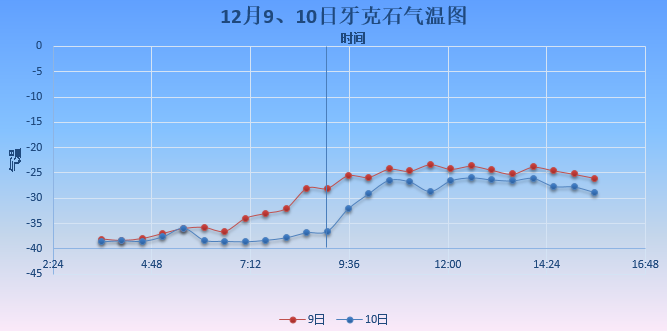
Part of the on-vehicle performance testing was carried out in Yakeshi to examine vehicle performance in extremely cold weather; the temperature chart for Yakeshi during the test is shown in Figure 12 below.
Figure 12 Local temperature chart for Yakeshi during the test
5.4 Low-temperature cold-start test
Testing the low-temperature cold-start condition of vehicles in extremely cold climates can reflect the ability of vehicles to adapt to different weather. Oil is one of the key factors affecting low-temperature cold starting, and oil with good low-temperature performance can deliver good cold-start capability.
The low-temperature cold-start test was carried out in accordance with the Competition Rules and with reference to national standard GB/12535-1990.
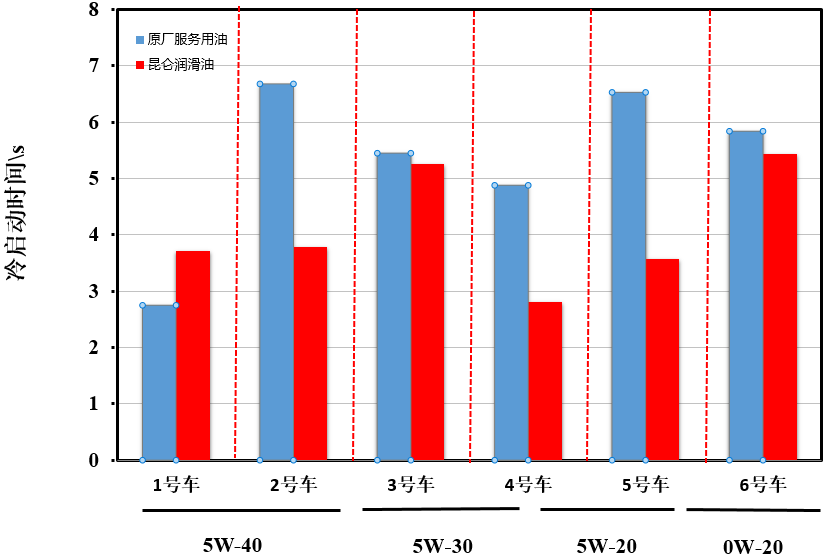
On December 8 and 9 the test vehicles were filled with the factory-fill service oil and Kunlun oil respectively and left outdoors to soak for 15 hours each, after which starting was attempted in order to measure the time for each vehicle to start normally. The low-temperature cold-start test conditions and results are shown in Table 9.
Table 9 Kunlun Lubricant Cup - 2018 China Car Performance Competition low-temperature cold-start test record sheet
Test date: December 9-10, 2018
Test location: CATARC test site
Road surface: hard-surfaced road
Weather: clear
Air temperature: -22/-38 degrees Celsius
Wind speed: 0.7 m/s
Test vehicle information
Low-temperature cold start
Type of oil
Test vehicle
Vehicle mileage
(km)
Factory oil
Starting time (s)
Kunlun lubricating oil
Starting time (s)
Test location
Car 1
879 km
2.75
3.71
Bosch outdoor car park
Car 2
874 km
6.68
3.78
Car 3
906 km
5.45
5.26
Car 4
869 km
4.88
2.81
Car 5
993 km
6.53
3.57
Car 6
948 km
5.84
5.44
Figure 13 Cold-start times of different oils
The weather charts for December 9 and 10 show that the temperature on the day the factory-fill service oil was tested was about minus 23 degrees Celsius, while the temperature on the day the Kunlun lubricating oil was tested was about minus 28 degrees Celsius. The low-temperature cold-start tests all succeeded on the first attempt, but the starting time with Kunlun lubricating oil was shorter.
5.5 0-60 km/h standing-start acceleration test
Testing the standing-start power performance of vehicles in a cold climate can assess their standing-start acceleration capability under different weather conditions. The friction characteristics of engine oil are one of the key factors affecting the standing-start stage, and good oil can deliver good standing-start acceleration capability.
The 0-60 km/h standing-start acceleration test was carried out in accordance with the Competition Rules and with reference to national standard GB/12543-1990.
On December 8 and 9 the test vehicles were filled with the factory oil and Kunlun oil respectively and left outdoors to soak for 15 hours each; after the low-temperature cold start of each test vehicle was completed, a 0-60 km/h acceleration test was carried out on compacted snow, with six runs per test vehicle and the average acceleration time recorded.
The specific test method was as follows: after refuelling to full, the vehicle drove to the same compacted snow surface and carried out a standing-start 0-60 km/h acceleration test on that same surface, using the YT1500 automotive road test instrument currently used at most domestic automotive test sites, with test data read directly from the instrument. Six runs were made per test vehicle and the average acceleration time was recorded. The 0-60 km/h standing-start test conditions and results are shown in Table 10.
Table 10 Kunlun Lubricant Cup - 2018 China Car Performance Competition 0-60 km/h standing-start test record sheet
Test date:
December 9-10, 2018
Test location: Yakeshi CATARC test site
Road surface: hard-surfaced road
Weather: clear
Air temperature: -22/-38 degrees Celsius
Wind speed: 0.7 m/s
Test results
Test vehicle
Test oil
0-60 km/h acceleration (s)
Average
Acceleration improvement rate, %
Car 1
Factory SN 5W-40
20.46
4.94
Kunlun SN 5W-40
19.45
Car 2
Factory SN 5W-40
12.52
6.87
Kunlun SN 5W-40
11.66
Car 3
Factory SN 5W-30
11.47
-4.53
Kunlun SN 5W-30
11.99
Car 4
Factory SN 5W-30
9.11
5.93
Kunlun SN 5W-30
8.57
Car 5
Factory SN 5W-20
15.51
2.13
Kunlun SN 5W-20
15.18
Car 6
Factory SN 0W-20
11.55
2.68
Kunlun SN 0W-20
11.24
Table 9 shows that after being filled with Kunlun oil, most vehicles showed improved power performance, with an average standing-start acceleration improvement of 3.0%.
5.6 Vehicle fuel dilution test
Fuel dilution is a common phenomenon that has always existed in internal combustion engines; in particular, vehicles with engines using in-cylinder direct-injection technology and vehicles operating in severe cold regions under frequent stop-start-stop-start driving conditions greatly amplify the effect of fuel blow-by, causing fuel and oil to mix and producing an obvious oil dilution phenomenon, the most direct result of which is a drop in the oil's viscosity.
Although the fuel dilution phenomenon is mainly related to engine design, a lubricant with good overall performance can alleviate it.
In accordance with the Competition Rules and with reference to standard NB/SH/T 04743, the fuel dilution rate of the oils was tested.
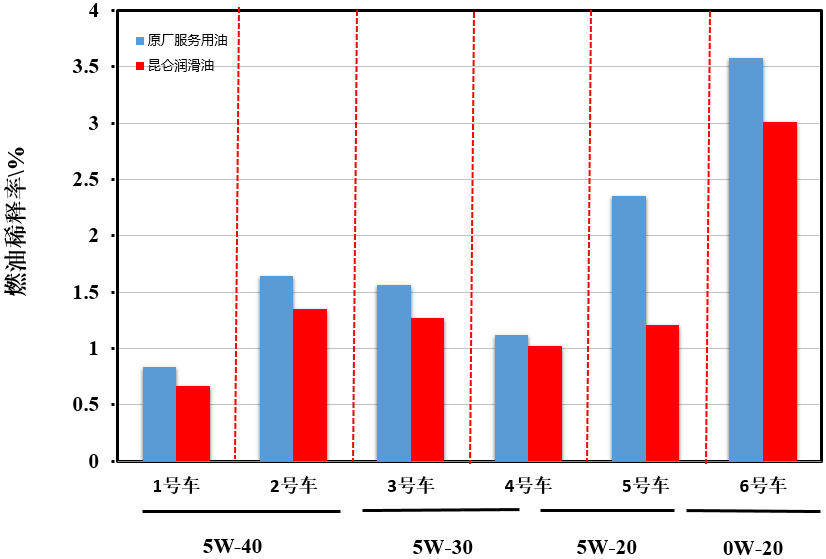
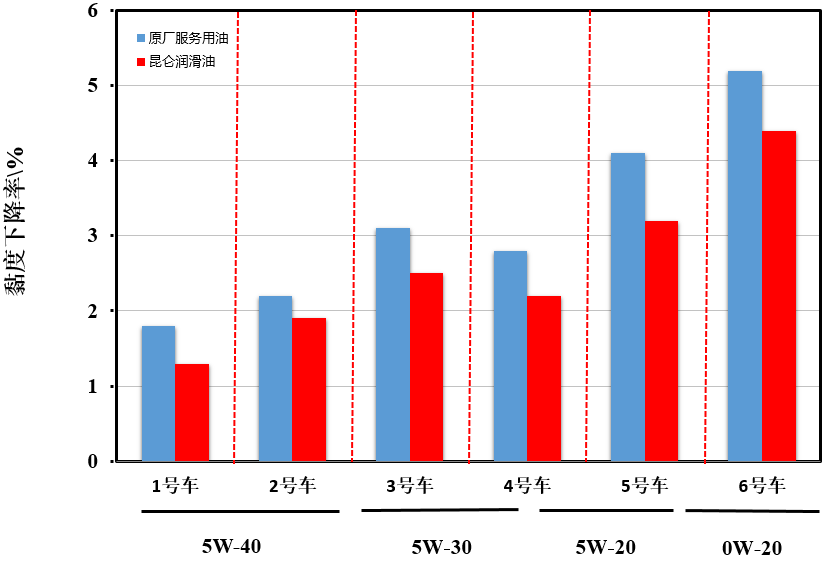
On December 8 and 9 the test vehicles were filled with the factory-fill service oil and Kunlun oil respectively, and the test vehicles carried out a six-hour driving test on the high-speed loop of the outdoor test site; after the test, oil was extracted from the six test vehicles at the dipstick position and the fuel dilution was measured using a gas chromatograph. The test conditions and results are shown in Table 11 and Figure 13.
Table 11 Kunlun Lubricant Cup - 2018 China Car Performance Competition fuel dilution and viscosity change record sheet
Test date:
December 9-10, 2018
Test location: Yakeshi CATARC test site
Road surface: hard-surfaced road
Weather: clear
Air temperature: -22/-35 degrees Celsius
Wind speed: 0.7 m/s
Test equipment: gas chromatograph
Test results
Test vehicle
Test oil
Fuel dilution
/ %
Fresh oil
Viscosity (mm2/s)
Used oil
Viscosity (mm2/s)
Viscosity
Decrease rate, %
Car 1
Factory SN 5W-40
0.84
14.15
13.89
1.84
Kunlun SN 5W-40
0.67
13.38
13.21
1.27
Car 2
Factory SN 5W-40
1.64
14.89
14.56
2.22
Kunlun SN 5W-40
1.35
13.38
13.15
1.72
Car 3
Factory SN 5W-30
1.56
11.30
10.95
3.09
Kunlun SN 5W-30
1.27
10.61
10.34
2.54
Car 4
Factory SN 5W-30
1.12
10.13
9.85
2.76
Kunlun SN 5W-30
1.02
10.61
10.38
2.17
Car 5
Factory SN 5W-20
2.35
8.58
8.23
4.08
Kunlun SN 5W-20
1.21
8.38
8.11
3.22
Car 6
Factory SN 0W-20
3.58
8.78
8.32
5.24
Kunlun SN 0W-20
3.01
8.72
8.34
4.36
Figure 14 Fuel dilution rates of different oils
Figure 15 Viscosity decrease rates of different oils
In the fuel dilution test results, the fuel dilution rates of five vehicles were below 2.5%. According to the requirement for fuel dilution greater than 5.0% in the national standard GB/T 8028-2010 oil change indicators for gasoline engine oils, none of the six vehicles reached the requirement for an oil change. However, excessively high fuel dilution causes the lubricant's own viscosity to fall too quickly, preventing the lubricant from forming an effective oil film and aggravating wear on the corresponding engine components. After fuel and oil mix, oil with better performance retains its viscosity well and will not suffer too rapid a viscosity drop because of fuel ingress, preserving the basic performance of the lubricant. In this test, Kunlun engine oils showed lower fuel dilution and better viscosity retention than the factory-fill service oils.
5.7 Vehicle idle noise test
While the full popularisation of cars brings people convenience, consumers' pursuit of driving comfort is also increasing. The results of a survey by a market research agency on consumers' sensory experience while driving showed that consumers are most sensitive to noise, which ranked first.
Testing vehicle idle noise in a cold climate further demonstrates the ability of the oil to reduce idle noise for vehicles under extreme climate conditions.
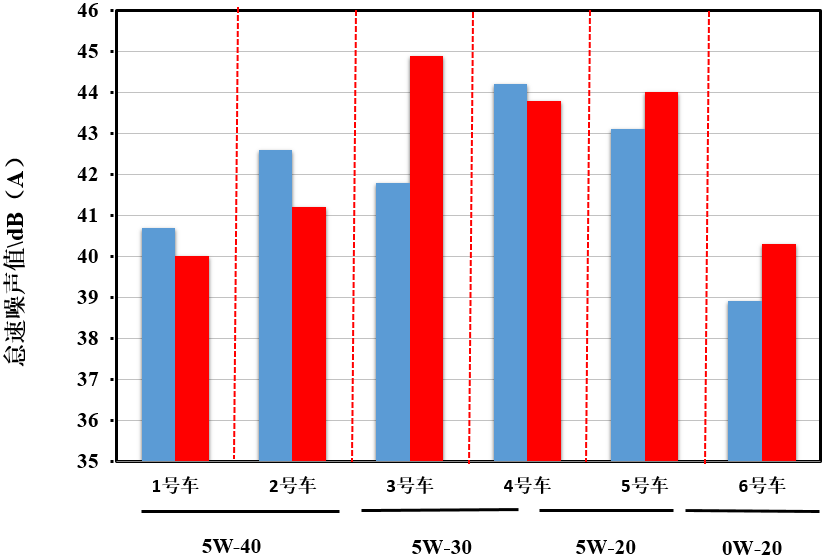
The engine idle noise test at the Kunlun Lubricant Cup - 2018 China Car Performance Competition referred to the CCPC Competition Rules and to GBT 18697-2002 Acoustics - Measurement of Noise inside Motor Vehicles. The test measured the in-vehicle idle noise of different engine oils in the same vehicle, with each measurement lasting 6 s and recording the A-weighted sound level LPA in dB. The vehicle idle noise test conditions are shown in Table 12 and Figure 15.
Table 12 Kunlun Lubricant Cup - 2018 China Car Performance Competition idle noise test record sheet
Test date:
December 9-10, 2018
Test location: Yakeshi CATARC test site
Road surface: hard-surfaced road
Weather: clear
Air temperature: -22/-38 degrees Celsius
Wind speed: 0.8 m/s
Test equipment: handheld noise meter
Background noise: 27 dB(A)
Test results
Test vehicle
Sound pressure level at the measuring point / dB(A)
Factory oil
Kunlun oil
Car 1
40.7
40.0
Car 2
42.6
41.2
Car 3
41.8
44.9
Car 4
44.2
43.8
Car 5
43.1
44
Car 6
38.9
40.3
Figure 16 Effect of different oils on engine idle noise
In the in-vehicle idle noise test, the in-vehicle noise of five vehicles was in the range of 38 dB to 44 dB. According to the classification of the urban regional environmental noise standard of the People's Republic of China, this noise level lies between category 0 and category 1 and represents a relatively quiet normal environment. In this test, both the Kunlun engine oils and the factory-fill service oils showed good quietness.
6. Conclusions
1. The physical and chemical analysis results show that both the factory-fill service oils and the Kunlun lubricating oils meet the standard requirements. With comparable viscosity at 100 degrees Celsius, Kunlun lubricating oils have higher high-temperature high-shear viscosity and lower dynamic viscosity and borderline pumping viscosity, and in theory provide better oil film strength and anti-wear performance in high-temperature environments and better low-temperature starting performance in low-temperature environments.
2. The simulation tests show that, compared with the factory-fill service oils, Kunlun lubricating oils have better high-temperature oxidation resistance and can provide more lasting high-temperature detergency protection for engines and turbochargers in high-temperature environments; they have a lower boundary friction coefficient, reducing the engine's friction power loss and providing the engine with a better energy-saving and friction-reducing effect; in the simulated low-temperature sludge test, Kunlun lubricating oils generated less sludge, providing better low-temperature sludge dispersancy for the engine; in the SRV anti-wear test, Kunlun lubricating oils showed more excellent anti-wear performance, which helps extend engine service life; and in the low-temperature fluidity test, Kunlun lubricating oils had better low-temperature fluidity, which corroborates the physical and chemical analysis finding that Kunlun lubricating oils have lower low-temperature dynamic viscosity and borderline pumping viscosity.
3. In the on-vehicle performance tests, compared with the factory-fill service oils, Kunlun engine oil achieved an average fuel saving rate of as much as 5.27%; under similar test temperatures, its low-temperature cold-start performance was consistent with that of the factory service oils; in the low-temperature environment, the 0-60 km/h standing-start acceleration test showed an average standing-start acceleration improvement of 3.0%, with lower fuel dilution and better viscosity retention; under plateau conditions, the 0-100 km/h standing-start acceleration test showed an average standing-start acceleration improvement of 3.43%; and in the NVH noise test, both Kunlun engine oils and factory engine oils showed good noise reduction effects.
China Automotive Technology and Research Centre
December 25, 2018
.y_jj h2,.y_jj h1{ font-size: 18px;text-align: left;line-height: 28px !important;}
table{ display: block; margin: 0 auto; text-align: center;line-height: 28px !important;}
table p{text-indent: 0 !important;line-height: 28px !important;font-family: "Microsoft YaHei" !important;}
span{ color: #787878 !important;line-height: 28px !important;}
span,p{font-size: 14px!important;line-height: 28px !important;;font-family: "Microsoft YaHei" !important;}
h1 span,h1{ font-size: 18px !important;line-height: 28px !important;}
h2 span,h2{ font-size: 16px !important;line-height: 28px !important;}
h3 span,h3{ font-size: 14px !important;line-height: 28px !important;}
.kl_xq h2{ font-size: 24px !important;}